Eight days of work. Four specialist artisans. One entire family. And a price that most people still think is too high.
Somewhere in the weaving belt of Bargarh district, the morning begins before sunrise. Threads hang across bamboo poles outside homes. Hands are dipping, lifting, wringing. Inside some homes, the wooden loom has already started its slow, rhythmic tak-tak. The hens walk between the workers' feet. Nobody pauses for them.
This is where your saree begins.
Not in a factory. Not on a machine. In a home, in the dark, before the rest of India has had its first cup of chai. By the time you hold that saree in your hands: feel the weight of the cotton, run your thumb along the border where the colours meet with that slight softness that only comes from natural dye on handspun thread. Someone has already given weeks of their life to it.
Most people never know that. And that gap, between what something costs and what it took to make, is exactly what this piece is about.
What You Are Actually Paying For
When someone sees the price on a Sambalpuri cotton saree and asks if it is expensive, the honest answer is: it is barely enough.
Not because the brand has decided so. Because of what physically happens before that saree reaches you. Four specialists. Stages that cannot be rushed or combined. Work that lives in human hands and nowhere else.
Here is what those hands do.
Stage One: The Designer
Every Sambalpuri saree begins with a drawing on paper. Not a digital file. Not a template pulled from last season. A hand-drawn pattern, created fresh, mapping out the border, the body, and the anchal separately. Each requires its own distinct composition.
The motifs carry meaning that goes back centuries. The shankha (conch), the chakra (wheel), the phula (flower). The fish-eye motif represents feminine grace. The elephant carries power. These are not decorative choices made casually. Each one is a decision made by someone who has spent a lifetime learning what a pattern holds.
Documented through field interviews with Surendra Meher, a national award-winning master weaver from Bargarh, this design work is the foundation of everything that follows. Without a precise paper blueprint, the tier cannot begin. And without the tier, there is no saree.
Stage Two: The Tier
Most people who own a Sambalpuri saree have never heard of the tier. This is the most technically demanding stage in the entire process, and also the most invisible.
The tier takes the raw cotton or silk yarn and calculates, from the designer's blueprint, exactly where to place each knot. Thread by thread. Cluster by cluster. These knots resist the dye. They are what creates the pattern that eventually floats to the surface only after weaving. If the tier misplaces a knot (not by much, just slightly) the pattern on the finished saree appears blurred, misaligned, broken. There is no fixing it after this point.
For a standard 48-inch saree, the warp frame requires precise configuration. Finer threads need more clusters; coarser threads fewer. Every variable changes the outcome. This is the kind of skill that takes years to build and cannot be shortened by effort or technology.
It simply takes the time it takes.
Stage Three: The Dyer
The tied yarn is now ready for colour. Sambalpuri weaving traditionally uses natural dyes, and the quality of the final colour depends entirely on the dyer's reading of conditions beyond any manual: the weather, the time of day, the quality of water. The threads are dipped, dried, and sometimes dipped again across multiple sessions depending on the depth of colour required.
The dyer reads all of these the way a musician reads a room, making adjustments that no formula could capture.
When you hold a Sambalpuri saree up to light and see colours that seem to float inside the fabric rather than sit on top of it, that is the dyer's work. It is not a print. It is not applied. It was built into the thread before weaving ever began.
Stage Four: The Weaver
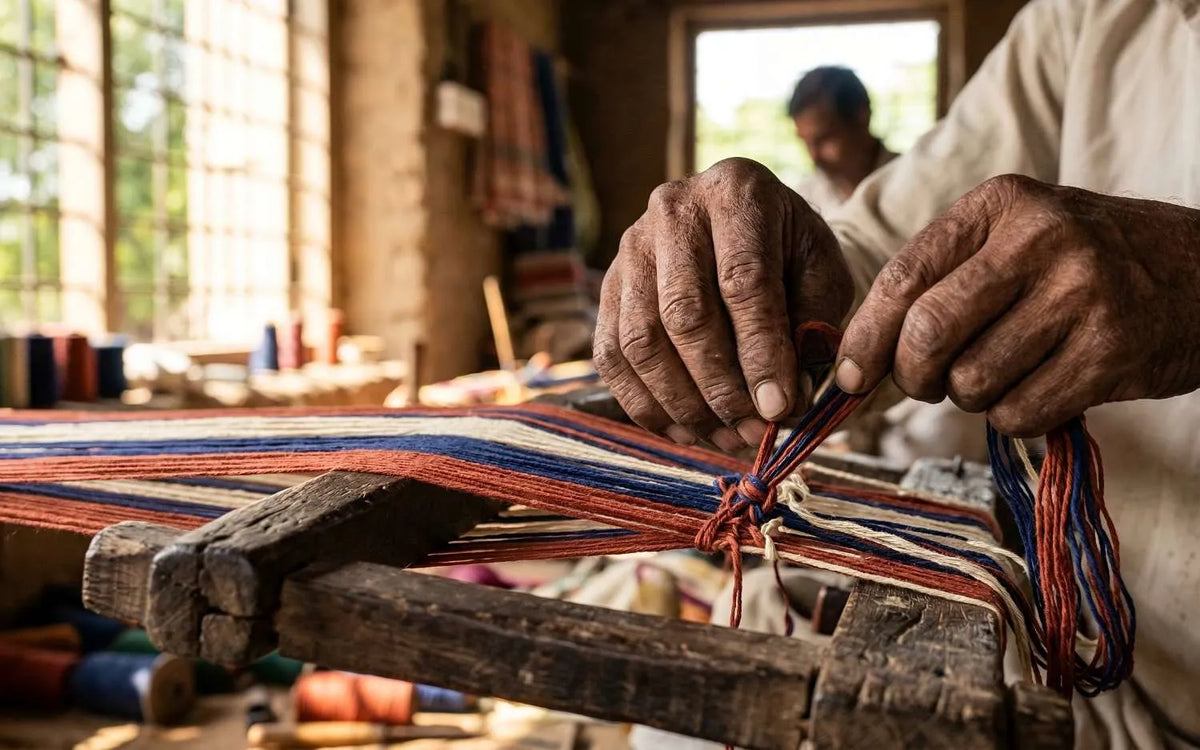
The warp and weft, now dyed with their knots removed, go onto the pit loom. The weaver sits low, feet working the pedals, hands passing the shuttle back and forth in that slow, deliberate rhythm. The tak-tak you hear from inside village homes is this.
A standard cotton saree takes a minimum of eight days at the loom. A piece with intricate design work takes months. Some of the most complex Sambalpuri sarees require six months of weaving alone, not counting the three stages before it.
Women and children work alongside throughout, helping with the preparatory tasks that frame each stage. The loom is never one person's work. It is a family's. Which means the saree you eventually wear carries the hours of people you will never meet, doing work that most of the world has already forgotten exists.
What the Artisan Actually Earns
This is the part of the story that almost never gets told.
Research by the Save Handloom Foundation is direct about it: a weaver working 10 to 14 hours a day typically earns between ₹300 and ₹500. That is the daily income. Not per hour. Per day. For work that demands years of training, sustained physical precision, and a level of concentration that does not allow for distraction.
When a saree moves through the traditional chain (from weaver to master weaver to trader to marketplace) the economics become harder to look at. The person who actually wove the saree may receive ₹400 to ₹600 of a ₹4,000 sale price. The one who got up before the sun. The one whose family worked alongside them.
This is not an exception. It is the system. And it has been running for decades.
What Changes When the Chain Is Removed
When a saree is sourced directly from the artisan family, without traders or aggregators in between, every rupee that was being captured in the middle goes somewhere else instead.
Fair wages. The ability to buy raw materials without borrowing from a master weaver who will extract it back later. Working capital. Dignity that is not conditional on debt.
The person who chooses a directly sourced handloom saree is not simply making a purchase. They are deciding where that money lands. They are deciding whose life it touches. That is a different kind of transaction entirely, and one that the artisan family feels in a way that a discount code never produces.
Read about how Taalapatra approaches this at our Transparency Pledge.
The Cheap Version Exists. Here Is What It Is.
The same visual style, machine-printed to mimic ikat, is available on mass marketplaces for a fraction of the price.
A machine made it in twenty minutes. The pattern sits on the surface, not inside the weave. Turn it over and the reverse side is blank, because nothing was woven into the thread, only applied to the face. That price goes to no one who sat at a loom before sunrise.
According to the Save Handloom Foundation, around 70% of what is sold as handloom in India today is either machine-made or power-loom fabric misrepresented as handcrafted. Most people who buy it never find out.
The gap between a machine-printed piece and a genuine handloom is not about luxury positioning or brand markup. It is the gap between something that was manufactured and something that was made. Between a pattern that was printed and a pattern that was tied, dyed, and woven into existence over days of human effort.
That gap is real. It lives in the fabric. You can feel it when you hold the two side by side.
What the Price Actually Means
Four people worked on your saree. A designer who drew the pattern by hand. A tier who placed thousands of knots with calculated precision. A dyer who read the light and water and temperature to pull the colour exactly right. A weaver who sat at a loom for eight days or more, with family beside them, doing work that no machine has yet been able to replace.
No two pieces from this process are identical. The slight variation in colour depth at the border, the faint irregularity in a motif that a machine would render perfectly uniform: these are not flaws. They are the evidence that a human being made this. Each piece is, in the truest sense, unrepeatable.
You are not paying for a saree. You are paying for all of this to have happened. For a family in Bargarh to have spent their morning doing what their grandparents did, in the hope that someone on the other end understands why it matters.
That is not expensive. That is what honest looks like.
A Note on Where This Comes From
Our artisans work directly with Taalapatra. No middlemen, no traders between the loom and you. Every Sambalpuri piece in our collection is the work of real hands, real families, and real time.
If you have read this far, you already understand what you are looking at when you see one.
Explore the Sambalpuri collection at Taalapatra
Frequently Asked Questions
Why are handloom sarees more expensive than printed ones? A handloom saree is made through a multi-stage process involving a designer, tier, dyer, and weaver, each a specialist. A standard Sambalpuri cotton saree takes a minimum of eight days of skilled labour to produce. A printed machine-made version takes minutes. The price reflects that difference in full.
How long does it take to make a Sambalpuri saree? A standard cotton Sambalpuri saree requires a minimum of eight days at the loom alone, not counting the design, tying, and dyeing stages. Complex pieces with intricate patterns can take three to six months in total.
What makes a Sambalpuri saree authentic? Authentic Sambalpuri sarees are handwoven using the bandha kala (ikat) technique: threads are tied and dyed before weaving, creating patterns that are identical on both sides of the fabric. The process involves four separate specialist artisans and cannot be replicated by machine. At Taalapatra, every Sambalpuri piece is sourced directly from weaver families in the western Odisha region, specifically from districts like Sambalpur, Bargarh and Sonepur — no middlemen, no traders — so authenticity is traceable to the loom it came from.
Is a handloom saree worth the price? Given that a weaver working 10 to 14 hours a day earns ₹300 to ₹500, and a saree requires eight or more days of their work plus three preceding stages, the price of a genuine handloom saree is one that allows for fair wages when sourced directly. Through traditional middleman chains, the weaver often receives only ₹400 to ₹600 of the final sale price, which means the price you pay determines more than you might think. Note that, by its fair trade principle, Taalapatra do not bargain on price with the artisans/weavers.
How does Taalapatra source its Sambalpuri sarees? Taalapatra works directly with artisan families in the weaving clusters of Sambalpur, Bargarh and Sonepur districts, removing traders and aggregators from the chain entirely. This means the weaver receives a fair share of what you pay, and every piece in the Sambalpuri collection is traceable to a real family and a real loom. You can read more about this approach on the Taalapatra Transparency Pledge.
Are the Sambalpuri sarees on Taalapatra genuine handloom? Yes. Every Sambalpuri saree at Taalapatra is handwoven using the traditional bandha kala ikat process. The simplest way to verify: turn the saree over. On a genuine handloom ikat, the pattern appears nearly identical on both sides because the threads themselves were dyed before weaving. A machine-printed imitation will have a blank or faded reverse. Taalapatra sources only from verified artisan families and does not carry power-loom or machine-printed pieces in this collection.
DISCLAIMER: The content in this blog is based on the author's research and understanding at the time of writing. While every effort has been made to ensure accuracy, information may vary and evolve over time. Taalapatra welcomes feedback and corrections. If you spot an inaccuracy, write to us at care@taalapatra.com.