A fireworks display, a hollowed horn, and one moment of royal curiosity that changed the lives of an entire artisan community in Odisha. This is how India's most unusual ethical craft came to life. And why it is now disappearing.
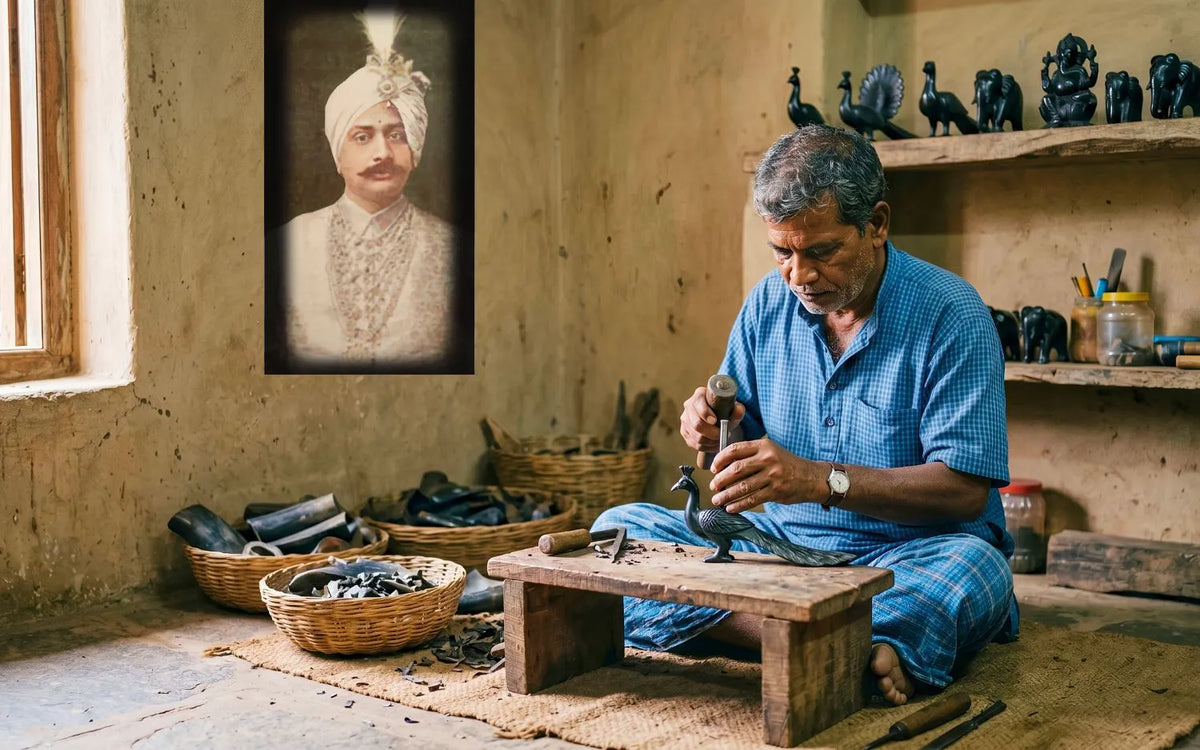
The year was somewhere in the early 1900s. A royal fireworks display was underway in Paralakhemundi, a small town in what is today Odisha's Gajapati district, at the time under the reign of Maharaja Sri Krushna Chandra Gajapati Narayan Deb. Someone had used a hollowed cattle horn as a container for the fireworks. The Maharaja noticed something that others had simply overlooked: the horn, when heated, became pliable. It could be shaped.
That observation might have passed as a curiosity and been forgotten. Instead, the Maharaja remembered a wooden crane sculpture he had seen and admired. He asked that a similar crane be made from the solid part of a horn. The artisan K.V. Appa Rao took up the challenge. The result pleased the Maharaja greatly. Appa Rao, with his eye for what the material could become, set up a workshop. The craft of horn carving in Paralakhemundi, as it exists today, traces its beginning to that single moment.
A Craft Older Than Its Modern Form
Horn as a material has been used across India for centuries. Ancient texts and archaeological evidence confirm the use of horn and bone for combs, knife handles, utensils, and small decorative objects long before modern craftspeople began working it. The Office of the Development Commissioner for Handicrafts, the Government of India's nodal agency for craft traditions, officially recognises Horn Craft from Gajapati district as one of Odisha's distinct handicraft forms, a recognition that traces its roots to the Maharaja's reign even as the tradition itself is older. But what makes Paralakhemundi's tradition distinct is not just its antiquity. It is the specific artistic vocabulary that developed here, under royal patronage, and the community of artisans called Maharanas who carried it forward.
The Maharanas were originally carpenters by birth and profession. They migrated from a place called Pitala in Ganjam district to Paralakhemundi under the patronage of the Gajapati rulers. It was their existing skill with tools, with form and proportion, that made them natural custodians of the new craft. When Appa Rao's workshop began attracting attention, more Maharanas took up horn work. Over the following decades, Paralakhemundi became synonymous with it.
In its early years, the craft was largely utilitarian. The first widely made items were combs: finely toothed, smoothly polished, deeply practical. During the Second World War, the artisans adapted to new demands, making razor handles, spectacle covers, and other everyday items. The decorative tradition, birds and animals and figurines, developed alongside and eventually overtook the utilitarian side as demand shifted.
The Journey to London
The moment that took Paralakhemundi's horn craft to the world happened in 1931. Maharaja Krushna Chandra Gajapati traveled to London to attend the Round Table Conference, one of the landmark political gatherings that shaped India's path toward independence. He carried with him, as gifts, a selection of horn combs made by Paralakhemundi's Maharanas.
Those combs, elegant and unusual, made an impression. Horn craft from this small Odisha town had reached the drawing rooms of London. For the artisans back in Paralakhemundi, it was the beginning of an international reputation that would, for a few decades, make their work truly famous abroad.
What the Craft Actually Is
Horn craft from Paralakhemundi uses cattle horn, from buffalo and cows, that has been naturally shed or collected after the animal's natural death. No animal is harmed or killed for the purpose of this craft. That ethical foundation is not a modern marketing claim. It is embedded in the nature of the material itself: horn from a living animal cannot be used the same way, and the tradition has always relied on what the natural world offers without being taken from it.
The process begins with preparing the raw horn. It is cleaned, cut, and sorted by colour and density. Natural cattle horn comes in a range of tones: from near-white to deep black, with every gradation of cream, brown, and grey in between. Experienced artisans read the horn the way a sculptor reads stone, identifying where the natural grain, colour, and density will serve the intended form.
Heating is the critical step. Horn becomes malleable at specific temperatures, a characteristic the Maharaja noticed during that fireworks display more than a century ago. Artisans heat the material carefully, using traditional methods, until it reaches the right degree of pliability. At this point it can be flattened, bent, or pressed into moulds. Once it cools, it holds its new shape permanently.
Carving and polishing follow. The forms created range from delicate bird figurines to peacocks, elephants, cranes, and horses. The natural grain of the horn, visible in the finished surface, gives every piece a visual depth that manufactured materials cannot achieve. Each piece catches light differently because no two sections of natural horn are identical.
The finished surface, after polishing, has a quality that has led horn craft to be compared to ivory: a similar translucency, a similar warmth. But unlike ivory, horn craft from Paralakhemundi involves no harm to any animal. That distinction matters enormously, both ethically and legally.
The Art That Almost Wasn't There
What makes this craft emotionally significant is how close it came to never developing at all. Without the Maharaja's observation at a fireworks display, a casual and fortunate moment of noticing, Appa Rao might never have been asked to carve that crane. Without Appa Rao's skill and commercial instinct, there would have been no workshop and no tradition to speak of.
Think about what that means. Every Maharana family that built its livelihood from this craft, every comb that made its way to a London drawing room in 1931, every peacock figurine that has sat on a shelf in an Indian home and caught the afternoon light through its polished surface: none of it had to exist. It existed because one man noticed something at a fireworks display that everyone else walked past.
That is not a small thing. Most craft traditions we speak of as ancient and inevitable were, at some point, equally contingent. A patron who cared. A craftsman who saw the possibility. A moment that held rather than passed. Paralakhemundi's horn craft is unusual only in that we know exactly when and how that moment happened.
The art form that exists today, the peacocks with their spread tails, the cranes in mid-motion, the elephants worked down to the texture of skin: all of it traces back to that single conversation between a king and a craftsman, in a small town in what was then Ganjam district, over a hundred years ago.
That fragility, the sense that everything could have been otherwise, runs through the tradition even now.
A Craft on the Edge of Disappearing
Today, Paralakhemundi's horn craft is in serious trouble.
The raw material that once came from the region has become difficult to source. The local buffalo population has declined sharply, and artisans now source horn from further afield. The number of active Maharana craftspeople working in horn has fallen dramatically. Young people who grew up in the community have moved to other livelihoods. The economic returns from the craft, in an era of cheap manufactured alternatives, rarely justify the years of skill development it demands.
The workshops that once defined Paralakhemundi's identity are far fewer than they were a generation ago. What the Maharaja set in motion in the early 1900s, what Appa Rao built with his hands and his workshop, what Maharana families passed down across four generations: all of it is now at real risk.
This is not a distant historical fact. It is happening now. The people who know how to heat horn to exactly the right temperature, who can read the grain of a piece of raw cattle horn and see the peacock inside it, are a small and shrinking community.
Why Owning a Horn Craft Piece Matters
When you hold a piece of genuine Paralakhemundi horn craft, you are holding the result of a tradition that survived a royal court, two World Wars, Indian independence, and decades of economic pressure. It reached London in 1931 as a diplomatic gift. It made a Maharaja pause during a fireworks display because something about the material refused to be ordinary.
It is also, in the most literal sense, cruelty-free. The horn came from an animal that lived its life and shed or died naturally. What would have been discarded became art. That is not a metaphor. It is how the craft works.
Each piece in Taalapatra's Horn Craft collection is sourced directly from artisan families in the Paralakhemundi tradition. Every purchase supports the Maharana community and keeps the skills in practice for one more season.
A piece like the Horn Craft Peacock Feeding Babies is one example of what these hands can still produce: a peacock tending to its young, carved entirely from natural cattle horn, polished to the characteristic warm sheen that has been this craft's signature for over a century. No two pieces are identical. The grain of the horn ensures that.
The question of whether this craft survives into the next generation will not be answered in Paralakhemundi alone. It will be answered, in part, by whether enough people in the rest of India and the world come to understand what it is, where it comes from, and what it means to hold it.
Few things worth Knowing
What is Paralakhemundi horn craft? Paralakhemundi horn craft is a traditional Indian craft form from Gajapati district in Odisha, in which artisans called Maharanas carve and polish figures, figurines, and decorative objects from naturally shed or ethically collected cattle horn. The craft developed under the patronage of the Maharaja of Paralakhemundi in the early 20th century and gained international recognition in 1931.
Is horn craft ethical and cruelty-free? Yes. Paralakhemundi horn craft uses cattle horn that has been naturally shed or collected after the animal's natural death. No animal is harmed or killed for the purpose of producing horn craft. This ethical foundation is inherent to the tradition, not a recent addition.
What makes Paralakhemundi horn craft unique? Several things set it apart. The use of natural cattle horn gives each piece a grain pattern, colour variation, and surface quality that cannot be replicated in manufactured materials. The heating and carving techniques developed by Maharana artisans over generations produce forms of real precision and delicacy. And the historical depth of the tradition, royal patronage, international exposure, more than a century of continuous practice, makes each piece a carrier of real cultural meaning.
Why is Paralakhemundi horn craft endangered? The craft faces declining raw material availability, falling artisan numbers as younger generations seek other livelihoods, and economic pressure from cheap manufactured alternatives. The community of active Maharana craftspeople working in horn has shrunk significantly, and the knowledge of traditional techniques is at serious risk of being lost.
Does Taalapatra sell authentic horn craft from Paralakhemundi? Yes. Taalapatra sources its horn craft directly from artisan families in the Paralakhemundi tradition, using naturally shed or ethically collected cattle horn. The Horn Craft collection includes pieces that represent the finest work this community currently produces. Every purchase directly supports the artisan families keeping this tradition alive.
DISCLAIMER: The content in this blog is based on the author's research and understanding at the time of writing. While every effort has been made to ensure accuracy, information may vary and evolve over time. Taalapatra welcomes feedback and corrections. If you spot an inaccuracy, write to us at care@taalapatra.com.