Somewhere in a museum in New Delhi, a small bronze figure stands on a shelf. She is 10.8 centimetres tall. Her left arm is stacked with bangles from wrist to shoulder. She has been standing there for over 4,000 years. She is the reason Dhokra jewellery exists.
Her name, given by archaeologists who unearthed her at Mohenjodaro in 1926, is the Dancing Girl. She stands in a relaxed contrapposto, one hand on her hip, head tilted slightly back. What makes her extraordinary is not just her age or her posture. It is how she was made. The same technique used to cast her bronze body, the lost-wax method, is the same technique that a Dhokra artisan in Odisha or Chhattisgarh uses today to make a brass necklace or a pair of earrings. Not a similar technique. Not a descendant of it. The same one.
That continuity is almost impossible to hold in the mind. Most things from 4,000 years ago are archaeological evidence, carbon-dated fragments of a world we can only reconstruct. Dhokra is a living tradition. It is being practised right now, in villages, by hand, using materials drawn from the earth and forest around the workshop.
What Dhokra Actually Is
Dhokra is the name for a specific method of metal casting, and also for the community of artisans who practice it.
The name comes from the Dhokra Damar tribe, nomadic metalsmiths who moved across what is today West Bengal, Odisha, Jharkhand, Madhya Pradesh, and Chhattisgarh, carrying their skills and tools from village to village. Wherever they went, they cast metal for local communities: ritual objects, lamps, vessels, animal figurines for worship, ornaments for adornment. Over centuries, they settled into specific regions while continuing the tradition. The craft became known by the tribe's name.
Technically, Dhokra is non-ferrous metal casting using the lost-wax technique. Non-ferrous means the metal used does not contain iron: typically brass (an alloy of copper and zinc) or bronze (copper and tin). The lost-wax technique, known in French as cire perdue and in Sanskrit texts as Madhu Chestan Vidhan, involves building an object in wax, coating it in clay, firing it so the wax melts and drains out, and then filling the void with molten metal. When the metal cools and the outer clay is broken away, the original wax form has been replaced by metal, held in every detail it carried.
The Dancing Girl was made this way. The Nataraja you see in museums was made this way. And the Dhokra necklace an artisan finishes today in a village in Dhenkanal was made this way.
The Making: Step by Step, Nothing Rushed
Understanding how Dhokra jewellery is made changes how you see it in your hands.
It begins with clay. Three types are used traditionally: black soil from the fields, fine clay from the riverbed, and soil from termite mounds. These are mixed with rice paddy husk, kneaded into a dough, shaped into the rough core of the object, and left to dry in the sun. This clay core determines the interior shape of the final piece.
Once dry, the wax work begins. Beeswax is mixed with damar resin from the forest tree Damara Orientalis and a small amount of nut oil. This mixture is rolled into long thin strands or flattened sheets. The artisan then works the wax by hand, wrapping strands around the clay core, building up surface patterns, adding details. This is where the motifs emerge: the spirals, the tribal faces, the geometric patterns, the nature-inspired forms. The wax is the artisan's drawing instrument. What is in the wax will eventually be in the brass.
Outer clay is applied over the finished wax model in layers, pressed carefully to capture every surface detail. A small vent is left at the base. The sealed model is fired in a kiln or traditional furnace. The wax heats, melts, and runs out through the vent. The clay shell remains, now holding a perfect negative impression of every pattern the artisan's hands built.
Molten brass is poured into this void. It fills every channel and curve that the wax once occupied. Once cooled, the outer clay is carefully broken away. Inside: the brass piece, still rough from the firing. It is filed, polished, sometimes fitted with cotton thread or glass beads, until it becomes a finished object.
This entire process, from clay core to finished piece, takes days. Sometimes longer for complex forms. And because the wax is built by hand and the clay broken away each time, no two Dhokra pieces are ever exactly the same. It is structurally impossible for them to be.
Why Dhokra Jewellery Feels Different to Wear
Dhokra jewellery does not look like other jewellery. That is the first thing most people notice. The surface is not smooth and reflective like manufactured metal. It has texture: the fine ridges of wax strands, the slight irregularities of hand-built patterns, the warm oxidised tone of brass that has been through fire. It looks like something made, not something produced.
The motifs come from the same visual language the Dhokra Damar tribe has used for centuries. Tribal faces, sometimes called Gajagamini (the woman with the grace of an elephant), appear on necklaces and pendants. The sun, the moon, spirals, leaves, geometric forms rooted in tribal cosmology sit alongside these figures. Nothing is purely decorative. Each element carries meaning that has moved across generations of oral tradition without ever being written down.
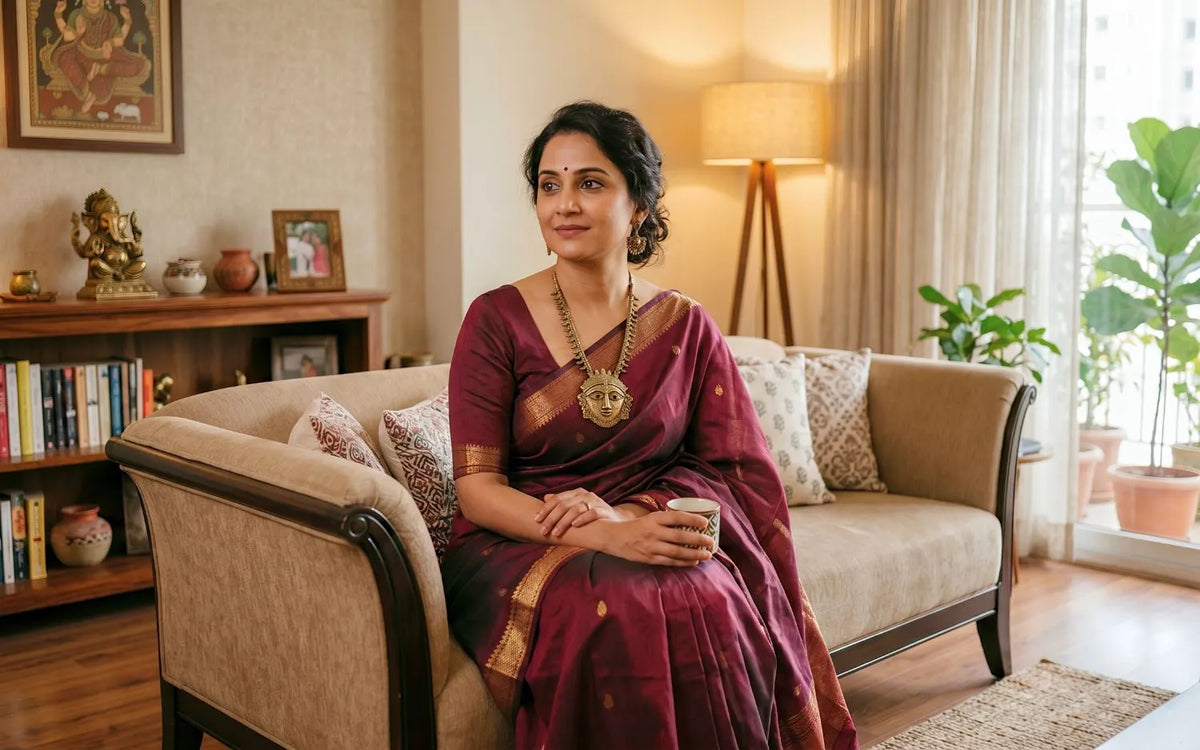
A Dhokra necklace is also lightweight despite its appearance. The hollow casting method means large-looking pieces do not carry the weight their visual scale suggests. This is one reason Dhokra jewellery works so naturally with handloom sarees and with contemporary clothing alike. The bohemian and ethical fashion movements internationally have taken note. What tribal communities in eastern India have worn for centuries is now sought by conscious consumers across the world.
The Regions, the Communities, the Living Craft
Dhokra is not one community in one place. It spans several states and several artisan groups, each with their own regional vocabulary within the shared tradition.
In Odisha, Dhokra artisans are found in villages across Dhenkanal, Rayagada, Kalahandi, and Mayurbhanj districts. The artisans there belong primarily to the Sithulia sub-caste of the Dhokra community and are known for intricate figurative work as well as jewellery incorporating cotton thread and glass beads alongside cast metal.
In Chhattisgarh's Bastar region, the tradition is particularly strong, with artisans making larger figurative pieces alongside jewellery. West Bengal's Bankura district has its own lineage, as do communities in Jharkhand and Telangana.
What unites them all is the process. The same clay, the same wax, the same fire, the same moment of breaking the outer shell to find what the metal has become.
The Gajagamini: A Motif Worth Understanding
If you look at Dhokra jewellery with any attention, you will find a face. Not a realistic face, but a stylised one: large eyes, defined features, sometimes framed with geometric headdress elements. This is the Gajagamini motif, one of the most iconic in Dhokra's visual vocabulary.
The word Gajagamini translates as "she who walks with the grace of an elephant." In Indian aesthetic tradition, particularly in classical poetry and dance, the elephant's gait represents a particular quality of grounded, unhurried dignity. The Gajagamini woman embodies this. She appears on Dhokra necklaces, pendants, and earrings as a celebration of feminine power expressed not through delicacy but through presence.
When Taalapatra's tribal jewellery collection, currently featuring Dhokra pieces, includes a piece named Gajagamini, it is drawing on this specific and ancient iconographic tradition. The name is not decorative. It is a piece of the tradition itself.
What Happens When Dhokra Becomes Jewellery
The conversion of an ancient metal casting tradition into wearable jewellery is not a recent development. Dhokra communities have made ornaments since the tradition began. What has changed is the scale of interest and who is wearing them.
Traditional Dhokra jewellery from Odisha combines the cast brass elements with cotton thread and sometimes glass or clay beads. The thread work makes the piece adjustable and wearable at multiple lengths. The contrast between the warm oxidised brass and the natural thread gives Dhokra necklaces a quality that neither element alone could achieve.
This is jewellery that ages well. The brass develops a richer patina over time. The thread softens. The piece that you buy today will look slightly different in ten years, and better for it. That is not a defect in the craft. It is how the material responds to being worn and lived with.
Taalapatra sources its Dhokra jewellery directly from artisan families in Odisha, working within the same lost-wax tradition that produced the Dancing Girl. The tribal jewellery collection currently features Dhokra pieces, with the collection planned to expand to include other traditional tribal jewellery forms as Taalapatra's artisan network grows.
For those drawn to the broader world of Dhokra craft beyond jewellery, the Dhokra/Brass Craft collection carries figurines, home decor objects, and decorative pieces made by the same artisan communities using the same lost-wax technique.
Why Buying Dhokra Matters Right Now
The Dancing Girl has survived 4,000 years. The question is whether the tradition that made her will survive the next 40.
Dhokra artisans across India face the same pressures that threaten most traditional craft communities: declining returns as machine-made imitations undercut the market, young people moving away from a skill that takes years to develop, and raw materials that are harder to source than they once were. An artisan who spends three days making a piece needs to earn enough from that piece to justify the three days. When the market fills with mass-produced versions that look similar in a photograph, that equation becomes hard to balance.
The difference between a genuine Dhokra piece and a cast-metal imitation is the same difference as between the Dancing Girl and a tourist replica. One was made by a human being who brought knowledge, judgment, and accumulated skill to a specific object. The other was reproduced. Both exist. Only one carries meaning.
When you choose Dhokra jewellery from a source with direct artisan partnerships, you are making a decision about which of these continues to be made.
FAQs
What is Dhokra jewellery?
Dhokra jewellery is handcrafted brass jewellery made using the ancient lost-wax casting technique, practiced in India for over 4,000 years. Artisans from the Dhokra Damar tribal community in states like Odisha, West Bengal, Chhattisgarh, and Jharkhand cast brass into intricate forms, often combined with cotton thread and glass beads, to create necklaces, earrings, and other wearable pieces with motifs drawn from tribal culture and nature.
How old is Dhokra craft?
The lost-wax technique used in Dhokra has been practiced in India for over 4,000 years. The Dancing Girl of Mohenjodaro, dated to approximately 2300 to 1750 BCE and now housed at the National Museum in New Delhi, is the earliest known example created using this technique. Today's Dhokra artisans use the same method.
How is Dhokra jewellery made?
Dhokra jewellery is made through the lost-wax casting process. A clay core is shaped and dried, then beeswax mixed with damar resin is hand-built over it with motifs and patterns. The wax model is coated in clay and fired: the wax melts out, leaving a mould. Molten brass is poured in, cooled, and the outer clay broken away to reveal the cast piece. Each piece is unique because the wax is built by hand and the mould broken after each casting.
What makes Dhokra jewellery unique?
No two Dhokra pieces are identical because each wax model is hand-built and each mould is broken in the casting process. The surface texture, oxidised brass tone, and hand-built motifs give Dhokra jewellery a quality that manufactured jewellery cannot replicate. The motifs, including tribal faces, spirals, and nature symbols, carry cultural meaning that has been preserved across generations.
What is the Gajagamini motif in Dhokra jewellery?
Gajagamini, meaning "she who walks with the grace of an elephant," is one of the most iconic motifs in Dhokra jewellery. It depicts a stylised female face and represents feminine dignity, power, and presence in Indian tribal tradition. It appears frequently on Dhokra necklaces and pendants.
Does Taalapatra sell authentic Dhokra jewellery?
Yes. Taalapatra sources its Dhokra jewellery directly from artisan families in Odisha, using the traditional lost-wax casting technique. The tribal jewellery collection currently features Dhokra pieces made from brass using traditional methods, with no middlemen between the artisan and the buyer. Taalapatra also carries a wider range of Dhokra craft objects in its Dhokra/Brass Craft collection.
How do I care for Dhokra jewellery?
Dhokra brass jewellery develops a natural patina over time, which is part of its character. Store it in a cool, dry place away from moisture. Wipe gently with a dry soft cloth. Avoid prolonged exposure to water, perfumes, and chemical cleaners. The cotton thread elements should be kept dry. The brass surface does not require polishing; the oxidised tone is an intended feature of the craft.
DISCLAIMER: The content in this blog is based on the author's research and understanding at the time of writing. While every effort has been made to ensure accuracy, information may vary and evolve over time. Taalapatra welcomes feedback and corrections. If you spot an inaccuracy, write to us at care@taalapatra.com.