A thousand years of devotion, natural pigments, and a single artisan's hand. And now it is sitting in a cardboard tube in your living room. Here is what to do next.
You finally have one. A genuine, handmade Pattachitra painting. Maybe it arrived rolled in cloth, packed carefully by the artist. Maybe you can still catch a faint scent of the natural lacquer finish that gives the surface its characteristic sheen. You unroll it, hold it up against the nearest wall, and realise you have no idea where it belongs.
That moment of uncertainty is more common than you would think. Pattachitra was never made for galleries or exhibitions. It was created to live in homes, in prayer rooms, in spaces where people ate, prayed, argued, and slept. And yet, most of us have grown up with walls full of framed photographs and printed artwork, not paintings that carry centuries of devotional weight. The rules feel different here. Because they are.
This guide walks through every room in the Indian home and tells you exactly how Pattachitra fits into each one, with Vastu guidance, styling notes, and specific examples of compositions that work best in each space.
Before the Wall: Understanding What You Have
Here is something most people do not fully appreciate until they have lived with a Pattachitra for a few years. The painting changes with light.
Traditional Pattachitra is painted on Tussar silk or hand-treated cotton cloth. The surface is built from layers of tamarind paste and chalk powder, polished to a texture that sits somewhere between leather and canvas. Natural pigments ground from minerals and plant sources: red from ochre, white from powdered conch shell, black from lamp soot, yellow from haritala. These sit on this surface in a way that synthetic paint on machine canvas simply cannot replicate. In the morning, warm golden light brings out the reds and yellows. By evening, the deep blacks and indigo take over.
This quality matters when you are deciding which wall to use and which direction it faces. A painting with this much light sensitivity deserves placement where it receives consistent, indirect natural light rather than direct afternoon sun, which fades natural pigments over time.
The characteristic thick black border with its floral motif that frames every traditional Pattachitra is also worth noting before you think about surrounding decor. That border does the visual work of separating the painting from everything around it. It is already a complete frame. Whatever you put near it should give it space, not compete with it.
The Living Room: Where Pattachitra Becomes a Statement
The living room is where hand-painted Indian wall art makes its strongest case. A large Pattachitra composition positioned as the single focal point on your primary wall does not just decorate that wall. It redefines the entire room's character.
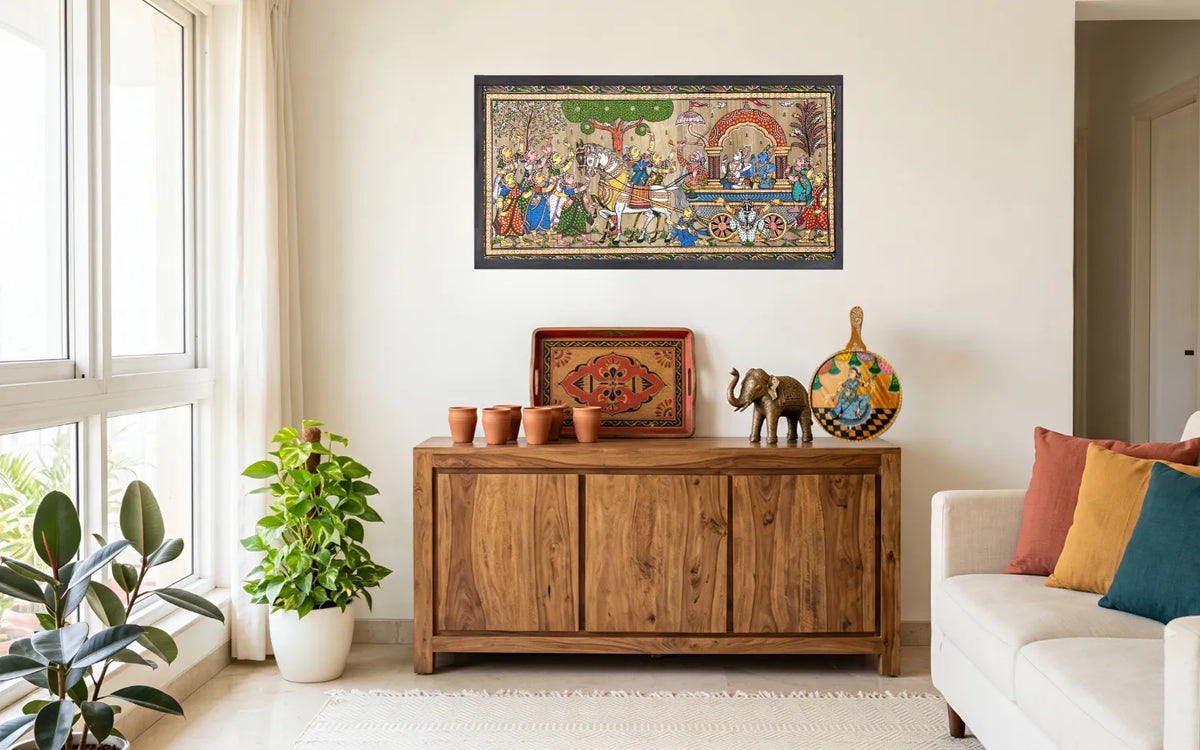
Mythological and epic narratives work particularly well here. Consider the Shri Jagannath Rath Yatra painting: an intricate depiction of the sacred chariot procession of Lord Jagannath, Balabhadra, and Subhadra, painted with the layered detail that makes Pattachitra wall art immediately recognisable across a room. The Rath Yatra theme carries enormous cultural resonance for Indian homes, devotional significance for those who revere Lord Jagannath, and sheer visual power for anyone who appreciates Indian traditional painting and Indian folk art. Hung on the wall facing the main seating area, a composition of this scale becomes a conversation before anyone speaks.
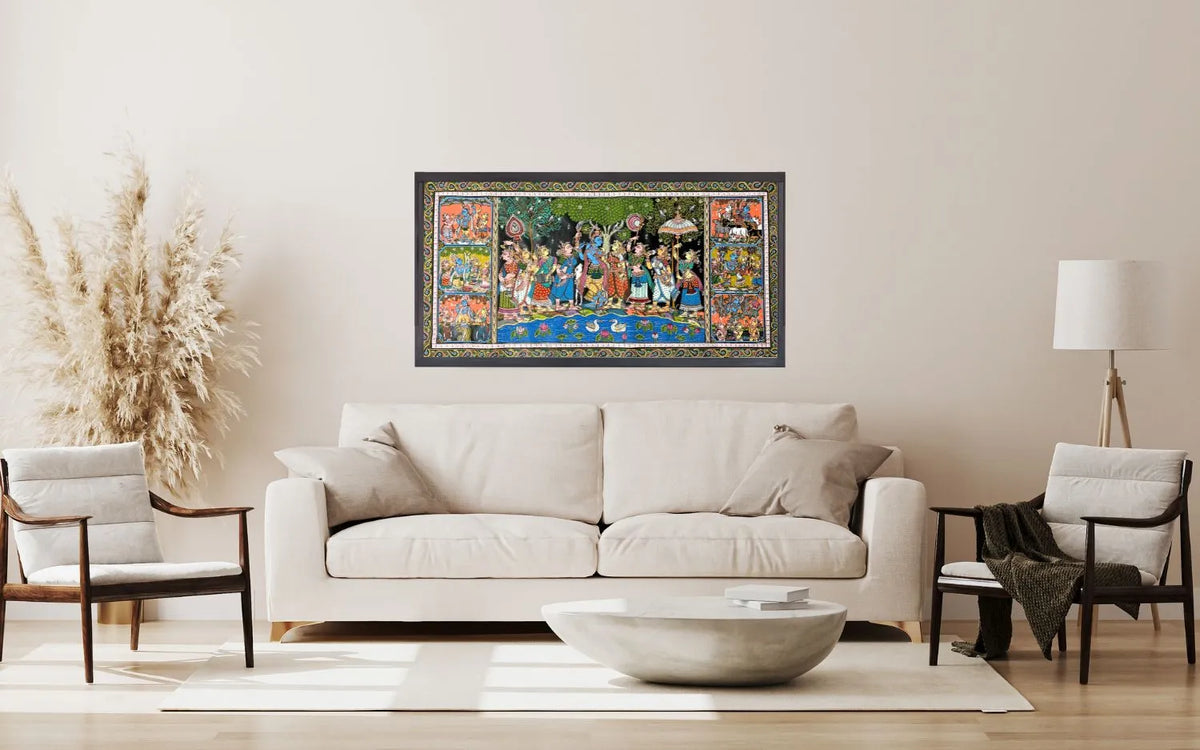
For homes that prefer something more intimate, the Radha Krishna Raas Leela Pond Side painting brings warmth and grace to a living space. The full-moon night setting, the interplay of figures, the reds and blacks rendered in natural mineral pigments: this is authentic Indian art that rewards looking for longer than most things on a wall.
A few notes on placement. Hang the painting so its centre sits at roughly 150 cm from the floor for a standing eye level, or 140 cm if the seating is low and you are mostly viewing it seated. Leave generous empty wall on all sides. Pattachitra for home decor does not benefit from being surrounded by other objects. It holds the wall on its own terms.
Vastu for the living room: The north or northeast wall is considered most auspicious for paintings depicting deities and sacred narratives, as these directions correspond to positive energy flow in Vastu Shastra. Avoid placing deity compositions on the south wall.
The Puja Room: Where This Art Was Always Meant to Be
Of all the rooms in a home, the puja room is where Pattachitra has its deepest roots.
The tradition began in Puri's Jagannath Temple as a devotional practice, a way of bringing the divine into the home when the deities themselves were not visible. That function is still alive. A Pattachitra in a puja room or mandir corner is not decoration. It is a continuation of a thousand-year-old tradition of sacred art living within domestic spaces.
The Panchmukhi Ganesh or Vaastu Ganesh painting on Tussar silk is one of the most considered choices for this space. Lord Ganesha's five faces each represent one of the Pancha Koshas, the five sheaths of human existence described in ancient Hindu philosophy: from the Annamaya Kosha (physical body) through to the Anandamaya Kosha (body of pure consciousness). As a Vastu painting, it carries both spiritual significance and the intention of positive energy in the home's most sacred corner.
Vastu for the puja room: The northeast corner of the home is considered the most sacred zone. A deity composition placed here, facing the devotee during prayer, aligns the space with principles of spiritual clarity and positive energy. The east wall is also deeply auspicious, associated with new beginnings. Whatever direction you choose, the image should face the worshipper, not a wall.
For compact puja spaces, a Tala Pattachitra on palm leaf carries as much devotional presence as a large silk piece. The monochrome etched quality of palm leaf paintings, black line on natural beige, is quietly powerful in small sacred corners. Explore the Palm Leaf Painting collection for pieces suited to these spaces.
The Bedroom: Choosing the Right Subject
Not every Pattachitra subject belongs in a bedroom, and this is worth thinking through before you hang anything.
Complex multi-figure battle scenes or dense narrative compositions with high visual energy are better suited to communal spaces where you are alert and active. A bedroom calls for compositions that are intimate, devotional, or quietly contemplative. The energy matters as much as the aesthetics.
The Radha Krishna Raas Leela Pond Side translates beautifully to a bedroom. Divine love and celestial union is one of the most auspicious subjects in Indian tradition for a couple's shared space. The composition itself, figures in graceful movement, soft water setting, the suggestion of moonlight carried through the blue pigments, settles into a room rather than asserting itself.
The Nari-Kunjar: Sri Krishna on Kunja Haati and intertwined Gopis painting is another deeply considered choice. In this composition, the intertwined figures of the Gopis form the shape of an elephant, a visual metaphor in which the material world is shaped and held together by divine consciousness. It is a subject that invites contemplation rather than excitement. A bedroom wall carries it well.
Vastu for the bedroom: The southwest wall governs relationships and emotional stability, making it ideal for Radha-Krishna compositions in a couple's room. The wall facing the bed works well for a single medium-sized piece. Avoid hanging any painting directly above the headboard.
The Entryway: The First Thing Your Home Says
The entryway sets the tone for everything inside it. It is the first thing a guest sees and the last thing you leave behind every morning.
A Pattachitra piece here does not need to be large. In fact, a carefully chosen medium-sized composition at this scale makes more of an impression than a large decorative print ever could, because it is immediately, unmistakably something real. Hand-painted Indian wall art at the threshold tells any visitor exactly what kind of home they are walking into.
Auspicious subjects are the strongest choice for an entryway. The Kanchi Abhijaan painting of Shri Krishna and Lord Balaram carries the narrative energy of divine purpose and grace. A Ganesha composition here is among the most traditional choices in Indian homes, the remover of obstacles greeting everyone who enters.
Vastu for the entryway: North or east walls at the entrance are considered auspicious, welcoming positive energy into the home. The painting should face inward, toward the interior of the house, rather than toward the door.
The Home Office and Study: Depth Without Distraction
A home office benefits from art that offers something to think about between periods of focused work, without pulling you into it so completely that you lose your train of thought.
Pattachitra's narrative structure, with its multiple registers of story organised within a single composition, is particularly suited to this quality of sustained but quiet engagement. You can look at it for thirty seconds and take something away. You can look at it for thirty minutes and still find something new.
The Shree Vishnu Dasavataar large canvas painting is perhaps the most compelling choice for a study or workspace. The ten incarnations of Lord Vishnu, each occupying its own register within a single composition, represent one of the most philosophically significant narrative sequences in Hindu tradition: the idea that purpose evolves across ages, that each era demands a different form of the same truth. For someone doing serious work, that is not a bad thing to have on the wall.
The Kanchi Abhijaan painting also works well here. Its story of divine grace meeting human effort with quiet, steady resolve is exactly the kind of presence that accompanies serious thinking without interrupting it.
Vastu for the study: East and north walls are associated with clarity of thought, new opportunities, and growth. These are the recommended directions for art in a workspace.
Framing, Lighting, and What Comes After
Most Pattachitra paintings arrive unframed. Framing is worth doing, and worth doing thoughtfully.
A simple dark wood frame, or a natural wood frame with a slight antique finish, works with almost every traditional Pattachitra composition without competing with the painting's own ornate border. Bright white frames pull the eye away from the art. Metallic silver frames do the same. The frame's job here is to hold the piece and protect it, not to speak for itself.
Glass front protection is particularly valuable for Tussar silk Pattachitra in humid climates. It protects the natural pigments from airborne moisture and reduces the need for regular maintenance considerably.
For lighting, warm-toned spotlights or adjustable wall-mounted lights positioned to fall across the surface at a slight angle bring out the texture of Tussar silk and the depth of the natural pigments in a way that overhead lighting never does. Overhead light flattens. Angled light reveals.
Care: Keep the painting away from direct sunlight, which fades natural mineral pigments over time. Avoid humid walls or rooms with significant temperature fluctuation. If unframed, dust gently with a dry, soft cloth. Do not use water or cleaning agents on the surface.
Pattachitra as a Housewarming Gift
Few gifts carry the weight that a genuine handmade Pattachitra does.
It is auspicious. It is culturally rooted. It is unrepeatable: no two hand-painted Pattachitra compositions are identical, which means the person receiving it holds something that exists nowhere else in the world. And unlike most things given at a housewarming, it does not sit in a drawer or get quietly replaced. It goes on a wall and stays there.
For gifting, match the composition to the recipient. A Ganesha or Jagannath composition works across most Indian homes. A Radha-Krishna piece is particularly meaningful for a couple's new home. The Dasavataar or Kanchi Abhijaan suits someone who appreciates art with philosophical depth.
Taalapatra's Pattachitra collection carries paintings sourced directly from award-winning Chitrakar artists, each made using natural pigments on Tussar silk or treated cloth canvas, with no middlemen between the artist and you.
For those drawn to tribal and nature-based themes rather than mythological narratives, the Saura/Tribal Painting collection offers a different visual language entirely: geometric, primal, and deeply rooted in the natural world. Both traditions are equally powerful on a modern Indian home wall. The choice depends on who you are buying for and what speaks to them.
Frequently Asked Questions
Which room is best for Pattachitra painting for home decor?
The living room suits large epic or devotional compositions as a single statement wall. The puja room is the most traditional and meaningful placement for sacred subjects like Jagannath or Ganesha. Bedrooms suit intimate compositions like Radha-Krishna. Entryways benefit from auspicious subjects. A home office carries complex narrative pieces like the Dasavataar particularly well.
Which wall should I hang a Pattachitra painting on as per Vastu?
For deity paintings, the north or northeast wall is most auspicious according to Vastu Shastra. The east wall suits compositions associated with new beginnings and health. For Radha-Krishna in a couple's bedroom, the southwest wall governs relationships. Avoid placing deity compositions on the south wall.
Does Pattachitra work in a modern or minimalist interior?
Yes, very well. Pattachitra's structured composition and natural colour palette work particularly well against plain cream, white, or grey walls. The painting's own traditional floral border does the decorative work. On a minimal wall, a single Pattachitra painting gains even more visual presence than it would in a heavily decorated space.
How do I frame a Pattachitra painting?
Use a simple dark wood or natural antique-finish frame. Avoid white or metallic frames. A glass front protects the surface from dust and humidity and is recommended for Tussar silk pieces in humid climates.
How do I care for a Pattachitra painting at home?
Keep it away from direct sunlight. Avoid high humidity spaces and walls prone to dampness. Dust with a dry soft cloth. Do not use water or cleaning products on the surface. A framed piece behind glass needs almost no ongoing care.
Does Taalapatra sell authentic handmade Pattachitra paintings for home decor? Yes. Every piece in Taalapatra's Pattachitra collection is sourced directly from award-winning Chitrakar artists using natural pigments on Tussar silk or canvas. Pieces span a range of subjects and sizes, from compact compositions for bedrooms and entryways to large-format narrative works for living rooms. All are unframed, handmade, and traceable to a specific artisan.
What is the difference between Pattachitra and Saura Tribal paintings?
Pattachitra is a devotional and mythological tradition from the Chitrakar community, characterised by dense linework, elaborate floral borders, and subjects drawn from Hindu epics and temple culture. Saura paintings are made by the Saura tribe of Odisha, featuring symbolic geometric figures rooted in nature, tribal rituals, and indigenous deities. Both are entirely hand-painted. Taalapatra carries both: the Pattachitra collection and the Saura/Tribal Painting collection.
DISCLAIMER: The content in this blog is based on the author's research and understanding at the time of writing. While every effort has been made to ensure accuracy, information may vary and evolve over time. Taalapatra welcomes feedback and corrections. If you spot an inaccuracy, write to us at care@taalapatra.com.