The truth about choosing a saree that will either become her most treasured possession—or your biggest regret
You're sitting at your desk, laptop open, scrolling through pages of Sambalpuri sarees at midnight. Your wife's birthday is next month. Your sister's wedding is in three weeks. Or maybe your mother mentioned she'd love one "someday."
They all look beautiful. They all claim to be "authentic handloom." They all seem... the same.
Except the prices range from ₹800 to ₹45,000.
And you have absolutely no idea why.
If this sounds familiar, you're not alone. Every year, thousands of well-intentioned gift-buyers make the same expensive mistakes when purchasing their first Sambalpuri saree. Not because they're careless, but because nobody explains what really matters until after they've already spent ₹12,000 on something that sits unused in the cupboard.
This isn't a typical buying guide. This is what I wish someone had told me before I bought my wife a saree she's worn exactly twice in four years.
Let's fix that for you.
The Gift That Changes Everything (Or Doesn't)
There's something almost transformative about gifting the right Sambalpuri saree. I've seen it happen. My colleague bought his wife one for their anniversary—she literally teared up when she opened it. Three years later, she still talks about it.
I've also seen the opposite. My friend spent ₹15,000 on what the seller called "premium silk Sambalpuri" for his mother. She smiled politely, wore it once to be nice, and it's been in her cupboard ever since.
Same price point. Completely different outcomes.
The difference? He knew what he was buying. I didn't.
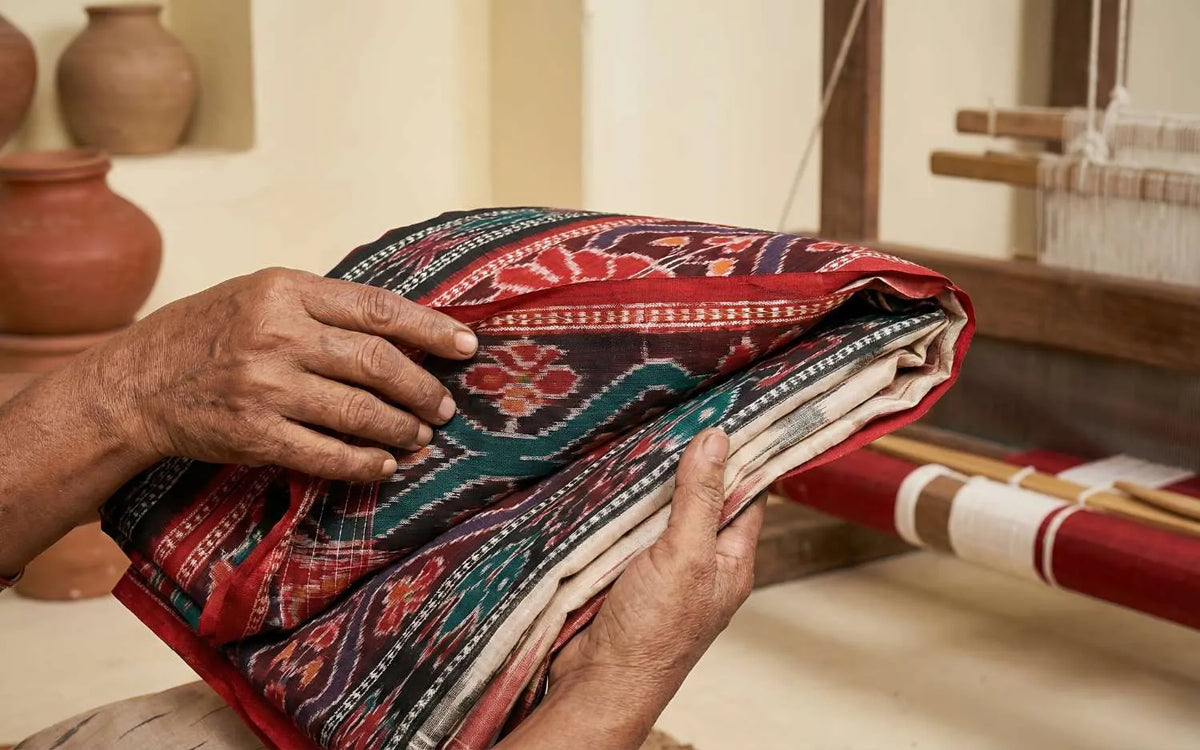
Here's what nobody tells you upfront: a Sambalpuri saree isn't just clothing. It's a 500-year-old tradition handwoven by artisans in the villages of Bargarh, Sambalpur, and Sonepur in western Odisha. It's a textile so intricate that the threads are tie-dyed before weaving—a technique called bandha kala, or "the art of tying."
But here's what they definitely won't mention in those flowery product descriptions: buying your first one is genuinely confusing if you're a guy. And making the wrong choice doesn't just waste money—it can make you look like you don't know the woman you're buying for.
So let's start with the brutal truth.
The Question You're Probably Not Asking (But Should)
Before we dive into thread counts, motifs, or authenticity markers, stop and answer this honestly:
What will she actually do with this saree?
Not what sounds impressive when you're telling your friends you bought her "authentic handloom from Odisha." What will really happen?
Will she:
- Wear it twice a year for weddings and major functions?
- Drape it for office events and festive occasions?
- Actually use it regularly because she loves handlooms?
- Keep it as a special piece to pass down someday?
Your answer changes everything about what you should buy.
Because here's the uncomfortable reality: cotton and silk Sambalpuri sarees are fundamentally different purchases. Different materials, different purposes, different prices, different care requirements.
Buying silk when she needs cotton is like gifting her stilettos when she asked for comfortable everyday shoes. Both are footwear. Neither is wrong. But one will just collect dust.
Cotton vs Silk: The Decision That Defines Your Purchase
Let me be direct: most first-time buyers choose based on budget or what looks "fancier," not what she'll actually use. This is backwards.
Sambalpuri Cotton Sarees: The Everyday Hero
Price range: ₹2,000 – ₹8,000
Best for: Office wear, regular functions, casual events, summer weddings
Weight: Light (300-400 grams)
Maintenance: Low (she can actually wash it at home)
Lifespan: 10-15 years with proper care
What salespeople won't tell you:
- Cotton Sambalpuri sarees are breathable and practical. She can wear one for a full day without feeling like she's wrapped in a blanket.
- They're surprisingly low-maintenance. Gentle machine wash is actually fine (don't tell the purists).
- The ikat patterns may be slightly softer than silk, but they're still visible on both sides—that's the hallmark of true bandha technique.
- Quality cotton holds colour beautifully. A well-made Sambalpuri cotton from 2010 still looks fresh in 2026.
The reality check: Cotton doesn't have the instant "wow" factor. It's elegant, absolutely. But if she's attending a high-profile wedding and wants to make an entrance, cotton might not deliver that moment.
When to buy cotton:
- She's mentioned wanting more handloom sarees for regular wear
- She values comfort and practicality
- You want her to actually use your gift, not just preserve it
- Budget is ₹2,000 – ₹7,000
Sambalpuri Silk Sarees: The Statement Piece
Price range: ₹10,000 – ₹50,000
Best for: Weddings, festivals, milestone celebrations, heirloom pieces
Weight: Medium to heavy (500-800 grams)
Maintenance: High (professional dry cleaning only)
Lifespan: Literally generations if stored properly
What nobody mentions:
- Silk Sambalpuri sarees have a presence that cotton simply cannot match. The lustre, the fall, the way it catches light—it's different. It announces her.
- The double ikat patterns are incredibly sharp because silk yarn holds dye with surgical precision.
- These are actual investments. A ₹25,000 silk Sambalpuri can be passed down to your daughter.
- Silk is temperamental. Sweat stains it. Perfume can discolour it. Sunlight fades it. She'll need to be careful with it.
The brutal truth: She'll wear it maybe 3-4 times a year. If you're spending ₹20,000+ on something that gets used quarterly, make sure that's intentional—not a surprise that causes guilt.
When to buy silk:
- It's a major occasion (milestone anniversary, significant birthday)
- She collects sarees and values heirloom pieces
- She has regular opportunities to wear formal sarees
- Budget is ₹10,000+
The Price Trap That Catches Everyone
You've definitely seen them online. "Authentic Sambalpuri Saree – Only ₹899! Limited Time!"
Let me save you the disappointment: it takes 4 days to 3 months to weave a single Sambalpuri saree, depending on design complexity. The ikat process alone—tying, dyeing, drying, untying, setting up the loom—requires serious skill and time.
So how can anything be ₹800?
Simple answer: It's not handwoven. It's machine-printed to look like ikat. The pattern is stamped onto fabric, not woven into the threads.
You're not buying heritage. You're buying polyester theatre.
How to Spot a Fake in 60 Seconds (Even If You Know Nothing About Sarees)
1) Flip it over and check the back
Real Sambalpuri ikat shows identical patterns on both sides because the threads themselves are dyed, not the surface. If the reverse looks faded or completely different, it's printed. Walk away.
2) Look for slightly blurred edges on the patterns
Handwoven ikat has naturally "feathered" pattern edges because threads shift microscopically during weaving. Machine prints have laser-sharp, perfect edges. Ironically, the slight imperfection proves authenticity.
3) Run your hand over the fabric
Handloom has tiny, natural irregularities in texture. Machine-made fabric feels robotically uniform and flat.
4) Ask about authenticity markers
Some sarees carry a GI (Geographical Indication) tag or handloom mark from weaver cooperatives. However, many genuine handlooms from individual master weavers don't have official tags. This doesn't make them fake—it means they work independently. What matters: transparent sourcing and visible double-sided weave.
5) Price reality check
Authentic cotton handloom: minimum ₹2,000
Authentic silk handloom: minimum ₹10,000
Anything significantly cheaper is machine-made, guaranteed.
The Motifs: What Those Patterns Actually Mean
Here's something interesting: Sambalpuri sarees aren't just randomly decorative. Every motif carries meaning rooted in Odisha's temple culture and spiritual heritage.
Shankha (conch shell): Divine sound, auspiciousness—linked to Lord Jagannath
Chakra (wheel): Lord Jagannath's chariot during Rath Yatra
Phula (flower): Nature's abundance
Elephant: Strength, wisdom
Fish: Prosperity
Pasapalli (chessboard): The most iconic pattern—inspired by the traditional game board, symbolises balance
When you gift a Sambalpuri saree, you're giving her wearable mythology. The same patterns her grandmother might have worn. The same symbols carved into 12th-century temple walls. The Indian handloom tradition recognizes Sambalpuri as one of the country's most significant heritage crafts, preserving techniques that date back centuries.
Practical tip for gifting:
Some motifs suit certain occasions better. Pasapalli is universally appropriate—safe choice for any event. Temple motifs (chakra, shankha) are perfect for religious functions. Floral and fish patterns work for celebrations and festivals.
Choose thoughtfully, and you'll look like you actually know what you're doing.
The Fabric Count System (And Why Sellers Hope You Don't Ask)
Here's insider knowledge most retailers pray you never learn:
Sambalpuri cotton sarees are graded by fabric count—a number from 40 to 120 indicating thread fineness and weave density.
40-60 count: Basic, coarser weave
60-80 count: Standard quality
80-100 count: Fine quality, softer
100-120 count: Premium, butter-soft
Why this matters to you:
A ₹3,500 saree in 60-count and a ₹6,500 saree in 100-count might look identical in photos. The difference is in how it feels against her skin and how many years it lasts.
What to ask the seller: "What's the fabric count?"
If they don't know or dodge the question, that tells you everything about their authenticity.
What She'll Never Tell You (But You Should Know)
Here's what I learned the hard way:
If it's cotton:
- The pleats won't stay crisp like synthetic sarees (solution: she'll need to use light starch after washing)
- It feels slightly coarse initially (it softens after 2-3 washes)
- It breathes—she won't sweat through it like she does with polyester
If it's silk:
- It's heavier than expected (she might need to practice draping it once before the event)
- The pallu tends to slip (she'll need to pin it securely in multiple places)
- It requires real care—this isn't something she can be casual about
The truth: The first time she wears your gift, it might feel unfamiliar. That's normal. Handloom has texture. It has weight. It has character.
By the third wear, she'll understand why women get addicted to handlooms.
Or she won't, and it'll sit in the cupboard forever. That's why choosing right matters.
Care Instructions (That Determine Whether Your Gift Lasts 2 Years or 20)
For Cotton Sambalpuri:
- First wash: Soak in cold water with 2 tablespoons rock salt for 15 minutes (sets the dye—this is crucial)
- Regular wash: Gentle hand wash or machine cycle with mild detergent. Never bleach.
- Drying: Always in shade. Sunlight permanently fades ikat colours.
- Storage: Fold along different creases every few months. Store in muslin/cotton cloth, never plastic.
For Silk Sambalpuri:
- First 3 wears: Dry clean only, no shortcuts
- Stains: Blot immediately with cold water. Never rub. Professional dry cleaner within 48 hours.
- Storage: Wrap in butter paper (prevents zari from oxidising). Add silica gel. Change folds every 2-3 months. Cotton storage bag, never plastic.
The mistake that ruins expensive sarees: Storing in plastic. Plastic traps moisture, causes yellowing, turns gold/silver zari black. If you want your ₹15,000 gift to look like trash in two years, use plastic.
Otherwise, insist on muslin cloth.
Questions to Ask Before You Buy (So You Don't Look Clueless)
A trustworthy seller will answer these confidently. A shady one will deflect.
1) "Is this single ikat or double ikat?"
Double ikat (both warp and weft dyed) is rarer and more expensive. Single ikat is more common. Both are authentic—just different price points.
2) "Which village was this woven in?"
Bargarh, Sambalpur, and Sonepur are the authentic hubs. If they can't tell you, they don't know their source.
3) "What's the fabric count?" (for cotton)
Above 80 is good quality. Above 100 is premium.
4) "Natural dyes or synthetic?"
Natural dyes (plant-based) are eco-friendly but pricier. Synthetic dyes are vibrant and colourfast. Both are fine—just know which you're getting.
5) "How long did this take to weave?"
Simple designs: 4-7 days. Complex: 15-30 days. Intricate double ikat: 60-90 days. If they say "one day," you're being lied to.
6) "Can you tell me the weaver's name and village?"
Trustworthy sellers working directly with artisans can answer this. Vague responses like "from Odisha" are red flags.
"But What About the GI Tag?" — The Honest Answer
You've probably read that authentic Sambalpuri sarees should have a GI (Geographical Indication) tag. Here's what's actually true:
The GI tag certifies regional origin and is managed by weaver cooperatives registered with the government. It's helpful—but it's not the only proof of authenticity.
Here's what sellers won't tell you:
Many of the finest Sambalpuri sarees come from individual master weavers who work independently, not through registered cooperatives. These artisans have perfected bandha kala across generations. Their work is absolutely genuine—they just don't have bureaucratic paperwork.
At Taalapatra, we prioritise transparency over tags. Instead of hiding behind certificates, we:
- Work directly with named weavers in Bargarh and Sambalpur
- Provide the artisan's name, village, and exact weaving timeline
- Guarantee handloom authenticity or refund double your money
- Show you the double-sided ikat weave machines cannot replicate
Think of it this way: A GI tag is like a Michelin star for restaurants. Nice to have? Sure. But plenty of incredible family-run places don't have Michelin stars—doesn't mean their food isn't outstanding.
What matters more than a tag:
- Can you see both sides of the pattern clearly?
- Does the seller know the weaver's name and village?
- Is the price justified by complexity and weave time?
- Can you verify the handloom texture yourself?
Trust the craft, not just the certificate.
The Mistake I Made (Learn From It)
I bought my wife a ₹12,000 silk Sambalpuri for our fifth anniversary. Burgundy and gold pasapalli pattern. Absolutely stunning.
She's worn it twice in four years.
Why? Because I bought for an occasion, not for her life. She doesn't attend enough formal events to justify heavy silk. What she actually needed—and has mentioned multiple times since—was a beautiful cotton Sambalpuri for festive Fridays at work and family gatherings. Something she'd wear monthly, not annually.
That ₹12,000 silk saree sits perfectly preserved in our cupboard, barely loved.
Meanwhile, my friend bought his wife a ₹4,500 cotton Sambalpuri in indigo and cream. She's worn it 40+ times. It's faded slightly. The pleats have permanent creases. It's her absolute favourite.
The lesson? Buy for the life she has, not the life you think she should have.
Ask her. Or ask her sister. Or her best friend. But don't guess on ₹10,000+ purchases.
The Taalapatra Difference: Why We're Different
At Taalapatra, we don't just sell sarees. We work directly with master weavers in Bargarh and Sambalpur—artisan families who've practiced this craft for generations.
Every saree comes with:
- The weaver's actual name and village
- Exact specifications (count, dye type, days to weave)
- Specific care instructions for that saree
- Our guarantee: if it's not genuine handloom, we refund double
Why? Because we've watched too many well-meaning gift-givers get burned by "authentic" sarees that aren't. Because we believe you deserve the truth, not marketing nonsense.
When you buy from Taalapatra, you know exactly what you're giving her.
Explore Our Sambalpuri Collection →
Before You Click "Buy": A Checklist
Make sure you can confidently answer:
✓ Does she need cotton (frequent wear) or silk (special occasions)?
✓ What's my budget, including care costs?
✓ Does the price make sense for the work involved?
✓ Can I see clear photos of the reverse side?
✓ Do I understand the motifs and what suits her taste?
✓ Has the seller answered my questions without dodging?
✓ Am I buying for her actual life, not an idealised version?
If you can't tick all these, pause. Do more research. Ask more questions.
Because here's the reality: Your first Sambalpuri purchase will either make you look like a thoughtful genius—or teach you a ₹10,000 lesson in what not to do.
Let's make it the former.
Common Questions Guys Ask
Can she wear it in summer?
Cotton Sambalpuri is perfect for summer—breathable and light. Silk is heavy; save it for air-conditioned events.
How often does it need washing?
Cotton: after every 1-2 wears
Silk: after 3-4 wears (less washing = longer life)
Will the colours bleed?
Not if the first wash includes the salt-water soak. Quality handloom dyes are permanent after that.
What if she doesn't like it?
Good sellers (like Taalapatra) accept returns within 7 days if unworn. Always check return policy before buying.
How do I know what size?
Standard sarees are one-size-fits-all (5.5-6 metres). If she's petite or very tall, mention it—sellers can recommend specific draping styles.
A Note on GI Tags & Authenticity
While this article mentions GI (Geographical Indication) tags as one verification method, we want to be transparent: not all authentic Sambalpuri sarees carry official GI tags. Many master weavers work independently outside cooperative structures. At Taalapatra, we verify authenticity through direct artisan partnerships, transparent sourcing, and guaranteed handloom quality—not bureaucratic paperwork alone. We believe you deserve to know exactly who wove the saree and where it came from, tag or no tag.
Your gift is waiting. But now you'll choose it with confidence, not confusion.
Because she deserves better than a beautiful mistake. She deserves something she'll actually treasure.
Discover authentic, artisan-woven Sambalpuri sarees at Taalapatra
Browse Sambalpuri Collection | Learn About Our Mission
DISCLAIMER: The content in this blog is based on the author's research and understanding at the time of writing. While every effort has been made to ensure accuracy, information may vary and evolve over time. Taalapatra welcomes feedback and corrections. If you spot an inaccuracy, write to us at care@taalapatra.com.