A journey into one of India's most treasured textile traditions, where every thread tells a thousand-year-old story
When you hold a Sambalpuri saree in your hands, you're not just touching fabric. You're holding a piece of living history—an art form that has survived empires, migrations, and the relentless march of time. This is the story of Sambalpuri Ikat, a weaving technique so intricate that historians trace its roots back to the 12th century, and so beloved that it adorns the idols of Lord Jagannath in Puri.
The Origins: A Craft Born from Migration
These artisans eventually settled in the western districts of Odisha, particularly in Bargarh, Sambalpur, Sonepur, Balangir, and Boudh. Here, in the quiet villages along the Mahanadi river, they perfected their craft over eight centuries, creating what we now recognize as Sambalpuri Ikat—locally known as bandha kala, which translates beautifully to "the art of tying."
What Makes Sambalpuri Ikat Unique?
The Technique: Patience Woven into Pattern
Unlike printed fabrics where designs are stamped onto woven cloth, Sambalpuri Ikat reverses the entire process. The magic happens before the weaving even begins.
Here's what makes it extraordinary:
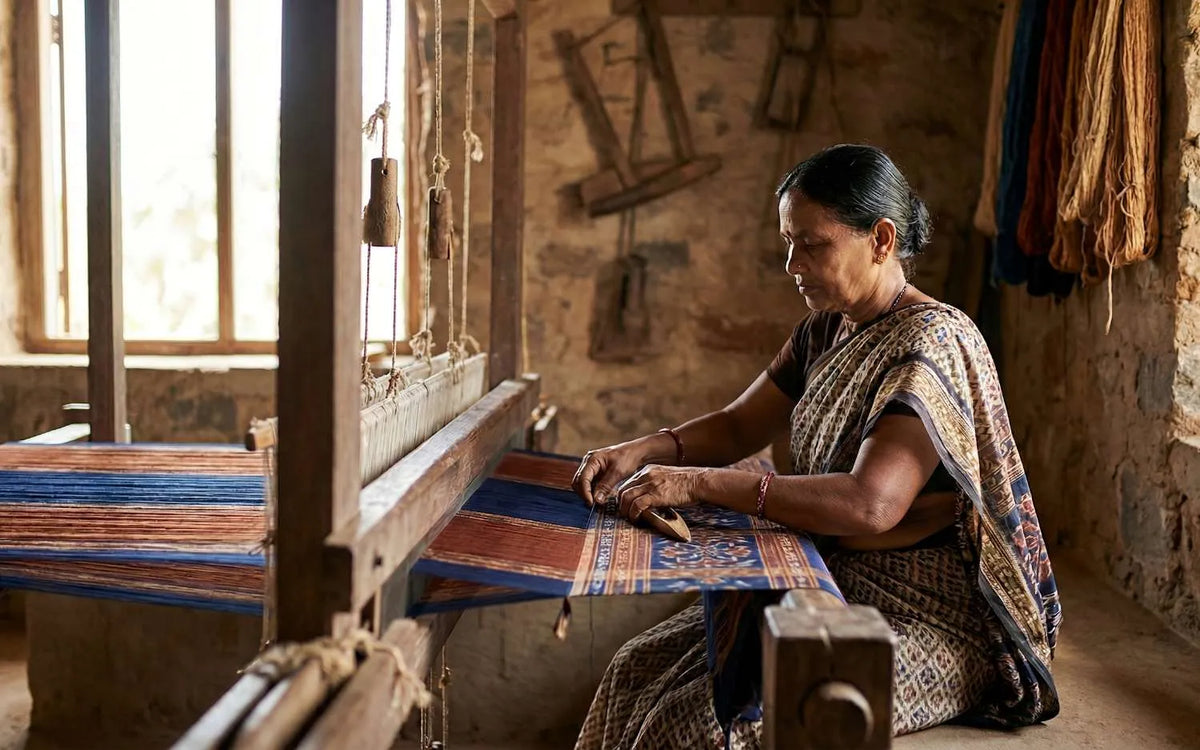
The yarns themselves are tie-dyed before they touch the loom. Artisans carefully calculate patterns on graph paper, then painstakingly tie sections of thread with precise knots to resist dye absorption. These tied threads are then dipped into natural dyes—sometimes three, four, or five times—to create the intricate multi-colored patterns that Sambalpuri textiles are known for.
When these pre-dyed threads are finally woven together on traditional pit looms, the pattern emerges like a photograph developing in a darkroom. It's a process that requires not just skill, but genuine artistry and mathematical precision.
Single Ikat vs. Double Ikat: The Difference
Sambalpuri weaving comes in two forms:
Single Ikat: Either the warp (vertical threads) or weft (horizontal threads) is tie-dyed before weaving, while the other remains solid-colored. This is the more common form.
Double Ikat: Both warp and weft threads are resist-dyed before weaving, then woven together so precisely that the patterns align at their intersection points. This technique is exponentially more complex and time-consuming, making double Ikat sarees treasured heirlooms. Bargarh and Sonepur districts are particularly renowned for their double Ikat craftsmanship.
The hallmark of authentic Sambalpuri Ikat is its characteristic "feathered" or slightly blurred edges—a natural result of threads shifting ever-so-slightly during the weaving process. This "imperfection" is actually what collectors prize most, as it proves the fabric is genuinely handwoven and not machine-printed.
The Time Behind Every Thread
Creating a Sambalpuri saree is not a quick endeavor. Depending on the intricacy of the design, a single piece can take anywhere from 4 days to 3 months to complete.
The entire weaver family participates—the designer conceiving patterns, the tier binding threads with mathematical precision, the dyer achieving perfect color tones using traditional techniques, and the weaver bringing it all together at the loom. As Sahapedia beautifully notes, "the lifestyle of a weaver becomes intimately linked to the very practice of weaving. The craft has become a way of life."
An average Sambalpuri saree requires well over a week of dedicated work by skilled hands, with every member of the household contributing to the creation.
The Language of Motifs: Nature, Devotion, and Daily Life
Sambalpuri textiles speak through their patterns. Traditional motifs fall into three categories:
Nature-Inspired: Phula (flowers), lotus blooms, creeping vines, fish swimming in rivers, elephants walking through forests. Every element reflects Odisha's lush landscape.
Sacred Symbols: Shankha (conch shells), chakra (wheel), temple architecture—all deeply connected to the worship of Lord Jagannath. In fact, many Sambalpuri sarees directly reference the colors of the deity's chariot during the famous Rath Yatra festival: green for Balabhadra, red for Subhadra, and yellow for Jagannath.
Geometric Patterns: The famous "Pasapali" design mimics the chequered pattern of a traditional game board, while "Bichitrapuri" represents one of the oldest known Sambalpuri styles.
One remarkable feature sets Sambalpuri Ikat apart from almost all other textiles: the pattern appears identically on both sides of the fabric. This mirror-image quality is possible only because the design is built into the yarns themselves before weaving begins.
Recognition and Protection: The GI Tag
In 2012, Sambalpuri Bandha Saree and Fabrics received India's prestigious Geographical Indication (GI) tag—a certification that legally protects the craft's unique identity and ensures that only authentic textiles from designated Odisha districts can carry the Sambalpuri name.
This recognition came after decades of effort by master weavers and government initiatives to protect the livelihoods of artisan families. The GI tag isn't just a certificate—it's a shield against counterfeit machine-printed imitations that threaten the survival of genuine handloom traditions.
The Masters Who Brought Sambalpuri to the World
While thousands of anonymous artisans have kept this craft alive for generations, certain names deserve mention:
Padma Shri Radhashyam Meher pioneered radical improvements in Sambalpuri techniques and quality, transforming a local craft into an internationally recognized textile art.
Padma Shri Kunja Bihari Meher, Chaturbhuja Meher, and Kailash Chandra Meher continued this legacy, each contributing innovations while honoring traditional methods.
Padma Shri Krutartha Acharya founded Sambalpuri Bastralaya, now considered one of Asia's largest primary weaving cooperatives.
But perhaps the most famous moment came when India's Prime Minister Indira Gandhi wore Sambalpuri sarees in the mid-1980s, bringing these textiles to national and international attention. What had been a cherished regional tradition suddenly became a symbol of India's handloom heritage on the world stage.
The Craft Today: Tradition Meets Modernity
While Sambalpuri textiles remain deeply rooted in tradition, they've evolved to meet contemporary tastes. Today, you'll find not just sarees, but:
- Dress materials and kurtis in handwoven ikat
- Home furnishings—curtains, bedcovers, cushion covers
- Scarves, dupattas, and stoles
- Men's shirts and jackets featuring traditional bandha patterns
- Modern fusion wear that blends heritage techniques with current silhouettes
Yet at its heart, Sambalpuri Ikat remains what it has always been: an extraordinarily labor-intensive craft practiced by skilled artisan families who have inherited this knowledge through generations.
Why Sambalpuri Ikat Still Matters
In an age of fast fashion and machine production, Sambalpuri weaving stands as quiet resistance. Every saree represents:
- Sustainability: Natural fibers, traditional dyes, zero industrial processes
- Fair wages: Direct support for artisan families without middlemen
- Cultural preservation: Keeping a thousand-year-old technique alive
- Unmatched quality: Textiles that last decades, not seasons
- Authentic heritage: Each piece is genuinely one-of-a-kind
When you choose a Sambalpuri textile, you're not making a purchase—you're making a statement. You're saying that traditions matter, that artisans deserve dignity, and that true craftsmanship is worth preserving.
Discover Authentic Sambalpuri Ikat at Taalapatra
At Taalapatra, we work directly with master weavers from Bargarh, Sambalpur, and Sonepur—the heartland of Sambalpuri Ikat tradition. Every saree in our collection carries with it the story of the artisan who created it, the village it came from, and the centuries-old techniques that brought it to life.
We believe in fair partnerships, not exploitation. When you purchase from Taalapatra, your money goes straight to the weaver families who poured their skill and time into each piece. No middlemen. No markup chains. Just authentic craftsmanship, honestly priced.
FAQs
What is Sambalpuri Ikat?
Sambalpuri Ikat, locally known as bandha kala or the art of tying, is a traditional handwoven textile from the western districts of Odisha. The yarns are tie-dyed before they touch the loom, so the pattern is built into the threads themselves, not printed onto the finished fabric. This is why the design appears identically on both sides of the cloth.
How old is Sambalpuri Ikat and where did it come from?
The tradition traces back to 1192 AD, when a community of weavers called the Bhulia migrated southward from northern India after the fall of the Chauhan empire. They carried knowledge of ikat tie-and-dye techniques, possibly influenced by the Patola traditions of Gujarat. Settling in the western Odisha districts along the Mahanadi river, they refined their craft over centuries into what we now call Sambalpuri Ikat.
What is the difference between single ikat and double ikat in Sambalpuri weaving?
In single ikat, either the warp threads or the weft threads are tie-dyed before weaving, while the other remains solid-coloured. In double ikat, both sets of threads are resist-dyed separately, then woven together so that the patterns align at every intersection point. Double ikat demands far greater precision and time, which makes those sarees particularly sought after. Bargarh and Sonepur districts are known for their double ikat work.
How long does it take to make a Sambalpuri saree?
Depending on the design, a single Sambalpuri saree can take anywhere from four days to three months to complete. The entire weaver family participates: the designer maps the pattern, the tier binds threads with precise knots, the dyer works the colours in stages, and the weaver brings it all together at the loom. A moderately detailed piece requires well over a week of dedicated work.
What are the traditional motifs found in Sambalpuri Ikat?
Sambalpuri motifs come from three traditions. Nature-inspired ones include phula (flowers), lotus, fish, and elephants. Sacred symbols include shankha (conch shell), chakra (wheel), and temple forms connected to the Jagannath tradition. Geometric patterns include Pasapali, which mimics a traditional game board, and the historic Bichitrapuri style. In all cases, the motif appears identically on both sides of the finished fabric, which is possible only because the design is built into the yarn before weaving begins.
Is Sambalpuri Ikat a GI-tagged craft?
Yes. In 2012, Sambalpuri Bandha Saree and Fabrics received a Geographical Indication tag from the Government of India. This certification legally ensures that only authentic handwoven textiles from designated Odisha districts can carry the Sambalpuri name. It was introduced specifically to protect weaver livelihoods from machine-printed imitations that look similar in photographs but have no connection to the handloom tradition.
Does Taalapatra sell authentic Sambalpuri Ikat sarees?
Yes. Taalapatra works directly with master weavers from Bargarh, Sambalpur, and Sonepur, the heartland of the Sambalpuri Ikat tradition. Every piece in the collection is handwoven using the traditional bandha tie-dye technique, sourced from weaver families with no middlemen involved. The collection includes cotton and silk pieces across a range of design complexity. Explore the Sambalpuri Saree collection to find the right piece.
Explore our Sambalpuri Saree Collection →
From traditional double Ikat masterpieces to contemporary adaptations in cotton and silk, we curate only the finest examples of this endangered art form. Each purchase helps preserve a tradition that might otherwise disappear in the face of mechanization and mass production.
Because some things are worth the wait. Some crafts deserve to survive. And some traditions, when they die, take irreplaceable beauty with them.
At Taalapatra, we're here to make sure that doesn't happen.
Discover. Preserve. Celebrate.
Browse Sambalpuri Collection | Learn About Our Mission
The content in this blog is based on the author's research and understanding at the time of writing. While every effort has been made to ensure accuracy, information may vary and evolve over time. Taalapatra welcomes feedback and corrections. If you spot an inaccuracy, write to us at care@taalapatra.com.