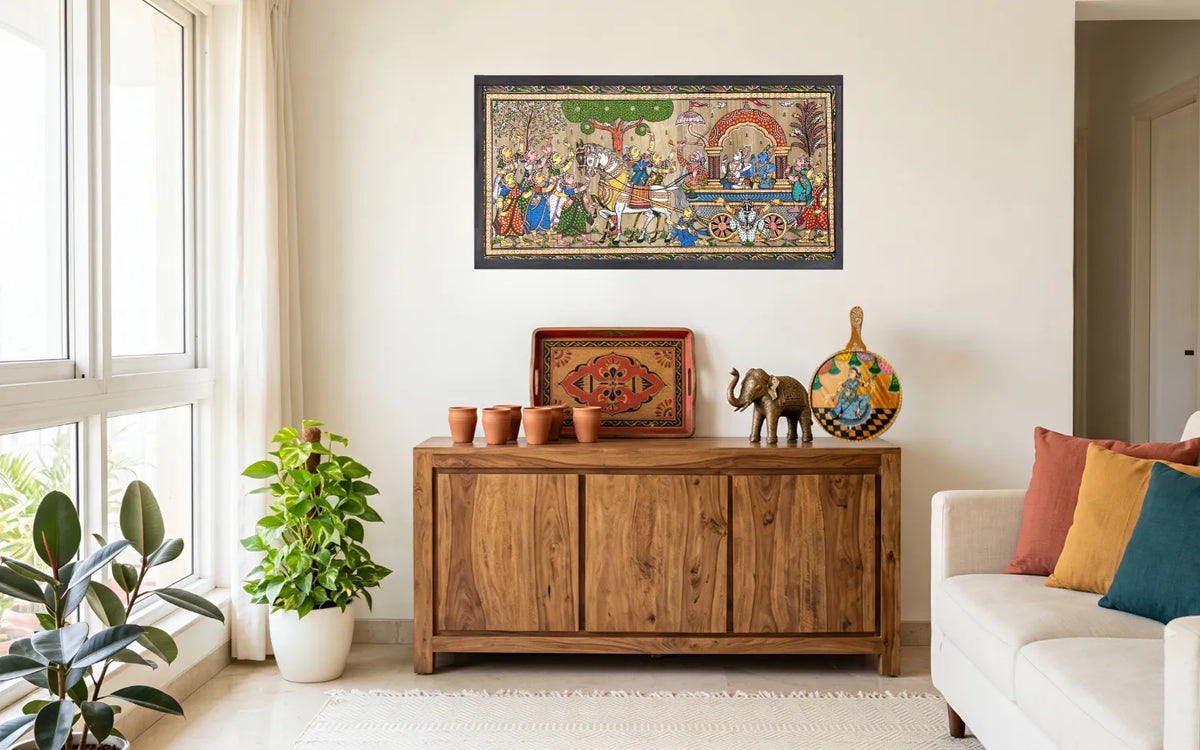
Walk into a home in Raghurajpur, Odisha, and you'll see Lord Jagannath's eyes following you from intricate cloth scrolls. Travel north to a village in Mithila, Bihar, and witness freshly painted walls blooming with geometric patterns celebrating a new bride. These aren't merely decorations—they're prayers made visible, stories told in pigment, and cultural memory preserved one brushstroke at a time.
Meet Pattachitra and Madhubani—two of India's most revered traditional painting styles. Though separated by geography and technique, both share a sacred origin: they were born not for galleries or collectors, but for the divine. And perhaps that's why, after surviving centuries of change, they still carry the power to move us.
Two Births, Two Devotions
The year is sometime in the 12th century. The place: Puri, Odisha—one of India's holiest pilgrimage sites and home to the great Jagannath Temple.
Every year during the *Snana Yatra* (sacred bathing ceremony), something extraordinary happens. Lord Jagannath, his brother Balabhadra, and sister Subhadra are taken for a ritual bath on the full moon day of summer. But the divine bath brings a consequence—the deities develop a ceremonial fever and must be kept away from public view for fifteen days, a period known as Anasar.
For devotees who traveled hundreds of miles to catch a glimpse of their Lord, these fifteen days were unbearable.
Enter the Chitrakars—the painter community of Puri. They created something ingenious: cloth paintings (patta meaning cloth, chitra meaning picture) depicting the deities in their various forms. These "Anasar Patti" paintings gave devotees a way to continue their worship even when the idols were hidden.
What began as a sacred substitute evolved into Pattachitra—a thousand-year-old tradition that today adorns not just temple walls, but homes and museums worldwide.
Madhubani: A Father's Love, A Bride's Art
Our second story begins even earlier, in the ancient kingdom of Mithila (present-day Bihar and parts of Nepal), sometime around the 7th or 8th century BCE, though the exact origins remain beautifully shrouded in legend.
The Ramayana tells us that King Janaka, ruler of Mithila and father of Sita, commissioned artists to paint the walls of his palace to celebrate his daughter's wedding to Prince Rama. The tradition took root—and for centuries afterward, the women of Mithila painted their homes to mark every significant life event: births, marriages, festivals.
But unlike Pattachitra, which was practiced primarily by male artists serving temples, Madhubani was—and remains—predominantly a women's art form. Mothers taught daughters, generation after generation, how to transform mud walls into visual prayers. The paintings illustrated hopes, dreams, fertility blessings, and protection for newlywed couples.
For centuries, these paintings existed only within homes, unseen by the outside world—until a devastating Bihar earthquake in 1934 exposed them to British colonial officer William G. Archer, who documented what he saw. The art form gained its name from the Madhubani district, meaning "forest of honey."
The Techniques: Where Precision Meets Devotion
Creating a Pattachitra painting is not a quick endeavor. It's a ritual in itself.
The Canvas Preparation:
Traditional Pattachitra isn't painted on store-bought canvas. Artists take old cotton cloth (often repurposed sarees), coat it layer by layer with a paste made from ground tamarind seeds mixed with water, then polish it with chalk paste and grinding stones until it achieves a leather-like texture. This process alone can take days.
The Natural Colors:
Every color comes from nature:
- White from ground conch shells and chalk powder
- Black from burnt coconut shells and lampblack
- Red from red ochre and sandalwood
- Yellow from turmeric and orpiment mineral
- Blue from indigo
- Green from mixing yellow and blue
Using brushes made from the hair of domestic animals—or even a single strand of mouse hair for the finest details—artists sketch with a pencil, then fill in with colors. The characteristic features emerge: figures with large, elongated eyes drawn from the front while faces turn sideways, elaborate borders framing every painting, and not a single empty space on the canvas.
The entire painting is typically done without shading or perspective—creating a flat, two-dimensional aesthetic that's instantly recognizable.
Time Required: Depending on complexity, a single Pattachitra can take anywhere from a week to several months.
Madhubani: The Language of Lines
Madhubani painting follows a completely different visual grammar, yet demands equal devotion.
The Traditional Base:
Originally painted on freshly plastered mud walls, the surface was first treated with cow dung mixed with water—a practice that not only created a smooth base but also helped preserve the natural pigments. Today, artists work on handmade paper, cloth, and canvas, though the traditional methods remain honored.
The Sacred Outline:
Unlike Pattachitra's sketched beginnings, Madhubani artists start with bold black or dark brown outlines drawn with bamboo sticks, matchsticks, or nib pens. This outline is sacred—once drawn, it cannot be erased or altered. The artist must commit fully from the first stroke.
The Natural Palette:
Madhubani artists create their colors from locally available materials:
- Yellow from turmeric and saffron
- Blue from Aparajita flower juice
- Pink from bougainvillea
- Green from flat bean leaves
- Black from cow dung mixed with charcoal
- White from rice powder
A cardinal rule of Madhubani: no empty space. Every inch of the surface must be filled with geometric patterns, dots, lines, or motifs. This horror vacui (fear of emptiness) creates the dense, intricate appearance that defines the style.
Colors are applied in flat, bold blocks—no shading, no gradients. The effect is striking: hypnotic, bold, unapologetically vivid.
The Visual Languages: How to Tell Them Apart
Pattachitra: The Realm of Mythological Precision
Subjects:
- Lord Jagannath in his various forms (Beshas)
- Radha-Krishna love stories from Jayadeva's Gita Govinda
- The ten incarnations of Vishnu
- Scenes from Ramayana and Mahabharata
- The mystical Navagunjara (a composite creature from Odia mythology)
Visual Characteristics:
- Elongated eyes: The most distinctive feature—large, almond-shaped eyes that seem to follow you
- Ornate borders: Every painting framed with intricate floral or geometric patterns
- Stylized figures: Flat, two-dimensional, with specific postures that identify gods from kings from sages
- Rich colors: Deep reds, ochre yellows, temple blacks, and blues dominate
- Mughal influences: In clothing styles and ornamentation
Madhubani: The Celebration of Sacred Geometry
Subjects:
- Fertility and marriage blessings (Kohbar paintings for bridal chambers)
- Hindu deities—Krishna, Shiva, Durga, Lakshmi, Ganesha
- Nature's elements: sun, moon, sacred tulsi plant, lotus flowers
- Fish, birds, animals (especially peacocks and elephants)
- Daily village life and celebrations
- Geometric precision: Circles, triangles, intricate line work, concentric patterns
- Double-line borders: Often filled with small floral or geometric designs
- Bold outlines: Thick, confident black lines defining every form
- Flat, vibrant colors: No shading—pure, saturated hues
- No empty space: The canvas is completely filled, creating dense visual tapestry
- Hypnotic eyes: Central faces often feature large, trance-like eyes gazing directly at viewers
- Bharni: Filled with solid colors, typically practiced by upper-caste communities
- Kachni: Intricate line work, minimal color
- Tantrik: Geometric and religious symbols, often monochrome
- Godna: Inspired by tattoo art, traditionally by lower-caste communities
- Kohbar: Bridal chamber art, focused on fertility and blessing symbols
The Communities: Who Keeps These Traditions Alive?
Pattachitra: The Chitrakar Families of Raghurajpur
The epicenter of this art remains Raghurajpur village in Puri district—designated as India's first heritage crafts village by INTACH in 2000. Walk through Raghurajpur today, and you'll find over 120 houses where nearly every family practices Pattachitra alongside other crafts like palm leaf engraving, stone carving, and cow-dung toy making.
The knowledge is patrilineal—fathers teach sons, who teach their sons. Yet it's a family affair: while men traditionally do the painting, women often prepare the canvas and colors. Some techniques are so sacred they're passed down only within families, never written, never shared outside the lineage.
National award-winning masters like Padma Shri Raghunath Mohapatra and Shilp Guru Jagannath Mahapatra have brought Pattachitra to international stages, but thousands of unnamed artisans keep the tradition alive in quiet devotion.
Madhubani: The Women Who Paint Prayers
Madhubani stands apart as an art form created, preserved, and dominated by women.
For centuries, it was passed mother to daughter as part of domestic life—girls learned to paint even before they learned to read, practicing for the culminating moment when they'd paint the kohbar ghar (bridal chamber) for their own weddings.
The transition from walls to paper came in the 1960s, following a devastating drought and famine in Bihar. The All India Handicrafts Board encouraged women to paint on paper as a means of income. What was once private ritual became public art—and economic empowerment.
Women like Padma Shri Sita Devi, Ganga Devi, Baua Devi, and Mahasundari Devi became legends—rare in a country where folk artists often remain anonymous. These pioneering women not only preserved their heritage but transformed it into a livelihood that supports entire villages.
Baua Devi was the only woman artist from India featured in the groundbreaking 1989 Magiciens de la Terre exhibit at Centre Pompidou in Paris—a watershed moment for Madhubani's global recognition.
Today, while men have begun learning Madhubani to meet market demand, it remains fundamentally a women's art form, passed through maternal lines, carrying centuries of feminine wisdom.
Recognition and Protection: The GI Tags
Madhubani Painting: GI tag granted in 2007
Pattachitra (Odisha): GI tag granted (Bengal Pattachitra received separate recognition)
The GI tags serve as shields against machine-made imitations flooding the market. They ensure that only authentic paintings from designated regions can carry these names—protecting both the craft and the livelihoods of thousands of artisan families.
However, enforcement remains a challenge. Cheap printed copies still masquerade as hand-painted originals, undermining artisans who spend weeks creating genuine pieces.
From Walls to the World: The Modern Evolution
What once appeared only on temple walls and home courtyards now adorns:
- Sarees and dress materials
- Home décor—wall hangings, cushion covers, lampshades
- Fashion accessories—scarves, bags, jewelry
- Stationery and corporate gifts
- Modern canvas art for urban homes
Madhubani artists now create works on women's rights, environmental conservation, social justice, and even COVID-19 awareness—proving the tradition is living, not fossilized.
Pattachitra has expanded beyond mythology to include modern interpretations while maintaining its signature style.
Yet at their core, both traditions remain what they always were: sacred acts of devotion disguised as decoration.
Why These Traditions Still Matter
Because they offer something no algorithm can replicate:
1. Human Touch: Every brushstroke carries the artist's hand, their breath, their prayer.
2. Cultural Memory: These aren't just paintings—they're living libraries of mythology, folklore, and ancestral knowledge.
3. Sustainable Beauty: Natural pigments, handmade materials, zero industrial waste. True eco-art.
4. Economic Empowerment: Especially for Madhubani's women artists, these paintings represent financial independence and dignity.
5. Spiritual Connection: Whether depicting Jagannath or a bridal blessing, these works carry intention, blessing, protection.
When you bring a Pattachitra or Madhubani painting into your home, you're not just buying art. You're preserving a technique that might otherwise disappear. You're supporting families whose ancestors perfected these methods over centuries. You're keeping India's visual heritage alive.
Discover Authentic Pattachitra at Taalapatra
Every painting in our collection carries the signature of its creator, the story of its creation, and the blessing of generations who perfected this sacred craft. We believe in fair partnerships, transparent pricing, and direct artist support—no middlemen diluting either the art or the artisan's earnings.
FAQs
What is the difference between Pattachitra and Madhubani painting?
Pattachitra is a devotional art form from Odisha, painted on cloth canvas by Chitrakar artisan families, featuring mythological narratives with dense linework, elaborate floral borders, and subjects from Hindu epics and the Jagannath tradition. Madhubani is from the Mithila region of Bihar, practiced predominantly by women, featuring geometric patterns, bold outlines, and subjects drawn from nature, marriage rituals, and Hindu deities. Both use natural pigments and follow a no-empty-space philosophy.
Where did Pattachitra painting originate?
Pattachitra originated in 12th century Puri, Odisha, at the Jagannath Temple. During the annual Anasar period when the deities were kept away from public view for fifteen days, Chitrakar artisans created cloth paintings of the deities so devotees could continue their worship. This sacred purpose gave birth to a tradition that has survived for over a thousand years.
Where did Madhubani painting originate?
Madhubani painting originates from the ancient kingdom of Mithila, in present-day Bihar and parts of Nepal. Legend traces its beginnings to around the 7th or 8th century BCE, when King Janaka commissioned artists to paint his palace walls to celebrate daughter Sita's wedding to Prince Rama. Women of Mithila continued the tradition for centuries, painting their homes to mark births, marriages, and festivals.
Do Pattachitra and Madhubani paintings have GI tags?
Yes. Madhubani painting received its Geographical Indication tag in 2007. Odisha Pattachitra also holds a GI tag, legally protecting both traditions from machine-made imitations and ensuring that only authentic paintings from designated regions can carry these names.
Who creates Pattachitra paintings?
Pattachitra is the hereditary craft of Chitrakar artisan families, primarily from Raghurajpur village in Puri district, which INTACH designated as India's first heritage crafts village in 2000. The knowledge passes from father to son. Women in Chitrakar families traditionally assist with canvas preparation and colour mixing. Taalapatra sources Pattachitra paintings directly from Chitrakar artisan families, with no middlemen between the artist and the buyer.
Does Taalapatra sell authentic Pattachitra paintings?
Yes. Taalapatra works directly with master Chitrakar artisan families from the Puri region, the heartland of authentic Pattachitra tradition. The collection includes traditional Lord Jagannath depictions, Radha-Krishna compositions, and large canvas masterpieces, each painted using natural pigments and traditional techniques. Every piece carries the signature of its creator. Explore the Pattachitra collection at taalapatra.com.
Explore Our Pattachitra Collection →
From traditional Lord Jagannath depictions to Radha-Krishna love stories painted on silk, from palm leaf miniatures to large canvas masterpieces—we curate only the finest examples of this ancient art form.
When you purchase from Taalapatra, you're not just acquiring a beautiful piece of art. You're becoming part of a movement to ensure that traditions this precious, this laboriously preserved, don't disappear in the face of mechanization and mass production.
Because some skills take lifetimes to master. Some stories deserve to be told in pigment. And some traditions, when they fade, take irreplaceable beauty with them.
At Taalapatra, we're here to make sure that doesn't happen.
Discover. Preserve. Celebrate.
Browse Pattachitra Paintings | Understand Our Mission
The content in this blog is based on the author's research and understanding at the time of writing. While every effort has been made to ensure accuracy, information may vary and evolve over time. Taalapatra welcomes feedback and corrections. If you spot an inaccuracy, write to us at care@taalapatra.com.