The loom starts before sunrise. By the time the rest of the village has made its first cup of tea, the shuttle has already crossed the warp a hundred times. This is how a Sambalpuri saree is born. Not quickly. Not cheaply. Not by a machine.
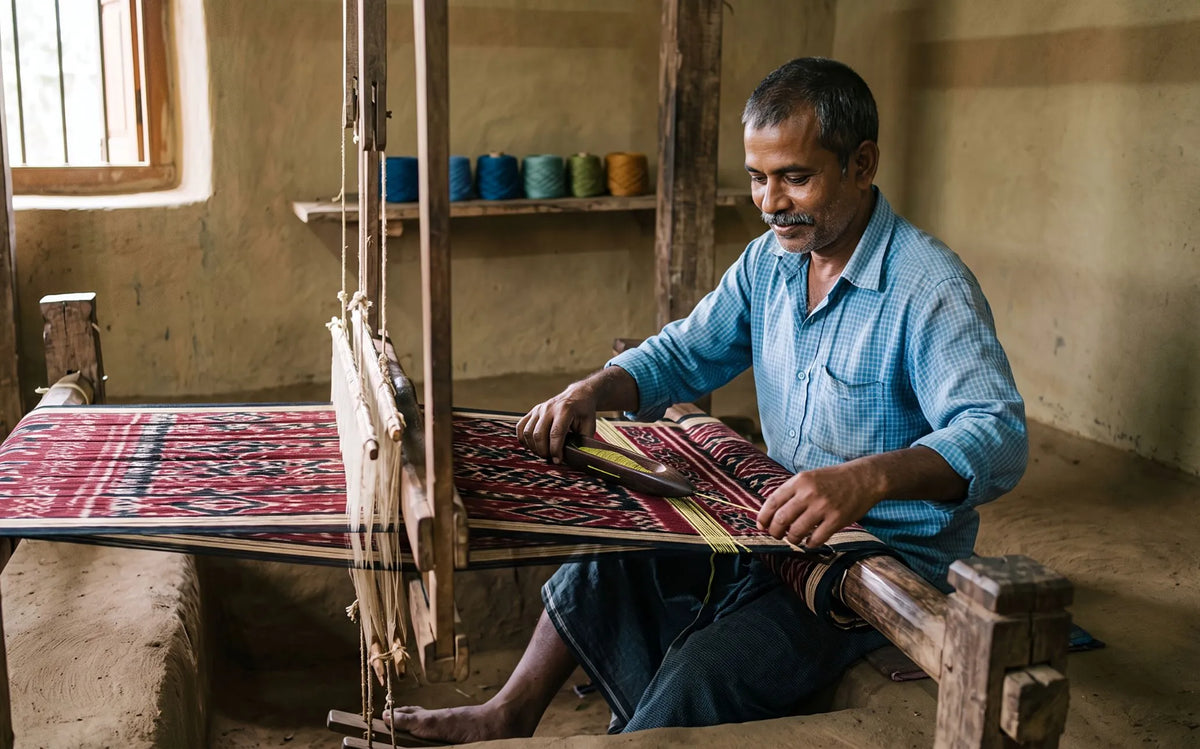
Walk into a weaver's home in the Bargarh district of Odisha and the first thing you notice is the sound. A rhythmic, wooden tak-tak that comes from a room just off the main living area, or sometimes from under the same roof as the kitchen. It is steady and unhurried. It does not speed up because someone is watching. It does not slow down because it has been going for hours. It simply continues, the way breathing continues, because the weaver knows exactly how long this will take and has made their peace with it.
That sound is a Sambalpuri saree becoming itself.
Where This Craft Actually Comes From
Most people who know Sambalpuri sarees associate them with the city of Sambalpur. The name suggests as much. But the great irony of Sambalpuri textiles is that they are not primarily made in Sambalpur at all.
The real production centre is Bargarh district, and the villages that surround it. Over 12,000 looms are active in Bargarh alone, according to Sahapedia's documented research with master weaver Surendra Meher, a national award recipient from the district. It is here, in homes that double as workshops, that the tradition lives most fully. Every household in certain villages has a loom. Every family has someone who knows how to use it.
The GI document for Sambalpuri Bandha Saree and Fabrics, the official Geographical Indication registered on 17 July 2012 by the Government of India, traces the roots of tie and dye weaving in western Odisha to 600 BC. Over those 2,600 years, the craft evolved through several waves of influence. In the 18th century, a community of Bhulia weavers migrated from northern India, bringing with them the knowledge of Gujarat's patola ikat technique. They did not simply reproduce what they knew. They transformed it, developing softer outlines, more curvilinear designs, and a visual vocabulary rooted in Odisha's temple culture and natural world that set Sambalpuri ikat apart from every other ikat tradition in India.
The weavers are primarily from the Meher community, divided into the Bhuliya, Kusta, and Kuli sects, each with their own specialisation within the craft. The Bhuliya weavers have long been associated with the finest silk work. The Kostha community, meanwhile, specialises in a different kind of silk weaving, producing the Kumbha saree and pieces with intricate butti work, tiny embroidered motifs spread across the body.
Before the Loom: The Work Nobody Sees
Here is the part that most people who admire Sambalpuri sarees never consider. The loom is not where the saree begins. By the time a weaver sits down to weave, the most technically demanding work is already done.
A Sambalpuri saree starts with a drawing on paper. The designer maps out the pattern on graph paper, plotting where each motif will fall on the body, the border, and the pallu. These motifs have remained largely consistent for generations. The shankha (conch shell), the chakra (wheel), the phula (flower): each carries meaning rooted in Odisha's temple tradition. The fish-eye motif. The deer. The lotus. The specific placement and proportion of each has to be worked out before a single thread is touched.
Then comes the tying. This is the bandha, the tie part of the tie-dye process, and it is where Sambalpuri ikat earns its reputation for difficulty. The raw yarn is stretched across a frame, and the weaver ties sections of thread with waterproof material, following the designer's blueprint, to resist the dye. Where a knot falls, the colour will not penetrate. When the knot is removed after dyeing, that section of thread will carry a precise point of un-dyed colour. Thousands of these knots, placed with millimetre-level precision, will eventually create the pattern visible in the finished saree.
If a knot is placed slightly wrong, the pattern on the finished saree will be blurred or misaligned. There is no fixing this after dyeing. The error carries all the way through to the final weave.
Body Bandha: When Both Warp and Weft Carry the Pattern
There are Sambalpuri sarees and then there are Body Bandha Sambalpuri sarees. The distinction matters enormously, and is what separates the most complex pieces from those that merely take days.
In standard Sambalpuri ikat, the pattern is created by tying and dyeing either the warp threads (running lengthwise) or the weft threads (running crosswise) before weaving. This is single ikat. One set of threads carries the design. The other provides the background.
In Body Bandha, both the warp and the weft are separately tied, separately dyed, and then aligned on the loom before weaving begins. The pattern must appear on both sets of threads in precisely the right positions so that when they cross each other during weaving, the motifs emerge correctly on the surface of the fabric. The margin for error at the tying stage is effectively zero. If the thread count is off, or a knot is fractionally displaced, the pattern will not resolve correctly no matter how skilfully the weaving is done.
This process, of separately planning, tying, and dyeing two sets of threads and then aligning them, is why a Body Bandha Sambalpuri silk saree can take months from start to finish. The dyeing stages alone, where threads are dipped, dried, and re-dipped for each colour in a multicolour design, can take four to eight days. Loom setup, threading the warp through the heddles in exact sequence, takes one to two additional days. And then the weaving itself, at five to six inches per day for a complex design, extends across weeks.
A recent documented example tells the full story clearly. When master weaver Guru Prafulla Meher worked on a commemorative Body Bandha silk saree, the weaving alone took 12 days. The complete process from design to finished piece took over three and a half months.
Three and a half months. For one saree.
The Loom and What Happens There
A traditional Sambalpuri loom is a pit loom. The weaver sits on a low platform with their legs in a pit below, feet on the pedals that raise and lower the warp threads to allow the shuttle to pass through. The action is entirely manual. There are no automated movements, no digital controls, no shortcuts.
The shuttle carries the weft thread across the warp. The weaver raises one set of warp threads, passes the shuttle, then reverses and passes it back. Every pass adds one line of weft. Every line has to align exactly with the dyed pattern on the warp threads. The weaver does not guess. They read the threads, checking constantly that the emerging pattern is resolving correctly as the fabric builds up.
On a standard cotton saree, a skilled weaver works four to eight days at the loom, according to Sahapedia's documented research with national award-winning master weaver Surendra Meher from Bargarh. On a complex Body Bandha silk saree, the loom work alone stretches to weeks. And the entire household is involved throughout. Women and children help with the preparatory work: winding yarn, tying, preparing the dye baths. The saree you eventually hold is the work of a family, not one pair of hands.
The Moment That Brought Sambalpuri to the World
The craft had been practiced for centuries within Odisha when a single moment changed its visibility entirely. Late Prime Minister Indira Gandhi wore Sambalpuri silk sarees, and suddenly the rest of India took notice.
That moment of recognition did not create the tradition. It did not improve the craft. What it did was give Sambalpuri weavers access to a market that had not previously found them. It is worth holding that fact clearly: the craft needed no improvement to earn national attention. It simply needed to be seen.
Today, Sambalpuri sarees carry a Geographical Indication tag, formally registered under the GI Act on 17 July 2012. They have been exhibited internationally and worn by collectors and textile scholars across the world. And yet, in many of the villages where they are made, the weaver who spent three months on a single saree still earns a daily wage that does not reflect the skill that wage is paying for.
What Reaches You at the End of All This
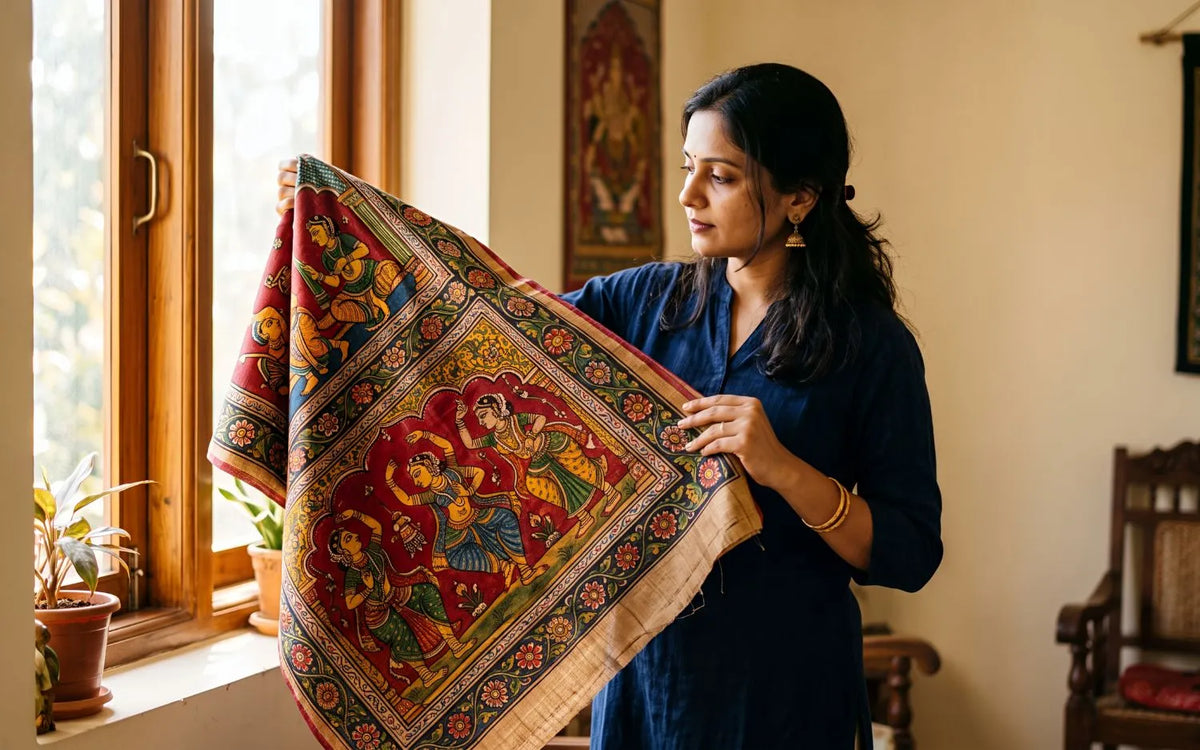
The Sambalpuri saree you hold, whether cotton or silk, simple border or full Body Bandha, carries months or weeks of a family's concentrated work. The pattern you see on the surface, those shankhas and chakras and phulathat appear identical on both sides of the fabric, is the result of knots placed by hand before a single thread was woven. The colour that sits in the thread rather than on its surface was built up through multiple dyeing sessions before the yarn ever touched the loom.
The slight irregularity in a motif, the natural softening of an edge that a machine-printed saree would render with mechanical sharpness, is not a flaw. It is the evidence that a human being made this. It is the mark of a hand that tied each knot individually, of a weaver who read the threads and made adjustments as the pattern emerged, of a family that worked across weeks or months toward a single finished piece.
Taalapatra's Sambalpuri saree collection carries pieces sourced directly from weaver families in the Bargarh district, working in the same tradition documented by master weaver Surendra Meher and built across 2,600 years of craft practice. Every piece in the collection is handwoven using the traditional bandha ikat technique, with no middlemen between the loom and you.
For anyone drawn to the full breadth of Taalapatra's handloom collection, the sarees collection brings together the complete range of handwoven pieces across traditions.
FAQs
How is a Sambalpuri saree made?
A Sambalpuri saree is made through a multi-stage process: design sketching on graph paper, tying sections of yarn with waterproof material to resist dye, dyeing in stages, setting up the loom, and weaving on a traditional pit loom. The defining feature is the ikat technique where threads are tie-dyed before weaving, creating patterns that appear identical on both sides of the finished fabric.
How long does it take to make a Sambalpuri saree?
It depends on the complexity. A standard Sambalpuri cotton saree takes four to eight days of weaving, with the complete process taking somewhat longer. A complex Body Bandha Sambalpuri silk saree, where both warp and weft threads are separately tied and dyed before weaving, can take weeks at the loom, with the complete process including design, tying, dyeing, and weaving extending to several months.
What is a Body Bandha Sambalpuri saree?
Body Bandha refers to double ikat, where both the warp (lengthwise threads) and the weft (crosswise threads) are separately tied and dyed before weaving. This is far more complex than single ikat, where only one set of threads is dyed. In a Body Bandha piece, both sets of threads must carry the pattern in precisely the right positions so the motifs resolve correctly when the threads intersect during weaving. This precision requirement is what makes Body Bandha the most time-consuming and prized form of Sambalpuri weaving.
Who weaves Sambalpuri sarees?
Sambalpuri sarees are woven primarily by the Meher community, divided into the Bhuliya, Kusta, and Kuli sects, concentrated in the Bargarh district of Odisha. The Bargarh district alone has over 12,000 active looms. The Bhuliya weavers are particularly associated with the finest silk work. National award-winning weavers including Surendra Meher and Padmashree recipient Kunjabihari Meher are among the most celebrated practitioners of this tradition.
What are the traditional motifs on a Sambalpuri saree?
The most traditional Sambalpuri motifs are the shankha (conch shell), chakra (wheel), and phula (flower), all of which are rooted in Odisha's temple culture. Other common motifs include deer, fish-eye, lotus, and birds. These motifs carry symbolic meaning and have remained largely consistent across generations of the craft.
Is Sambalpuri saree a GI-tagged product?
Yes. Sambalpuri Bandha Saree and Fabrics received its Geographical Indication tag on 17 July 2012, registered by the Government of India under the GI Act, 1999. The tag covers sarees from Sambalpur, Bargarh, Bolangir, and Sonepur districts of Odisha, formally recognising the craft's regional origin and protecting its name from imitation.
Does Taalapatra sell authentic Sambalpuri sarees?
Yes. Taalapatra sources its Sambalpuri sarees directly from weaver families in the Bargarh and Sonepur districts, working in the traditional bandha ikat technique. The Sambalpuri saree collection includes both cotton and silk pieces, with no middlemen between the artisan family and the buyer.
The content in this blog is based on the author's research and understanding at the time of writing. While every effort has been made to ensure accuracy, information may vary and evolve over time. Taalapatra welcomes feedback and corrections. If you spot an inaccuracy, write to us at care@taalapatra.com.