Walk into a home filled with handcrafted Indian art and something shifts. The room does not announce itself. It simply holds you differently. That quality has nothing to do with how much was spent. It has everything to do with what was chosen.
Most modern Indian homes are decorated the same way. A furniture showroom sofa. A glass coffee table. A few framed prints from the nearest decor store. The walls are neutral, the surfaces are tidy, and the overall effect is pleasant but unmemorable. Nothing in the room has a story. Nothing required anyone's hands.
This guide is for the home that wants to be different. Not maximalist. Not overwhelming. Just specific, curated, and rooted in something real. Here is how to use Indian handcrafted art and objects, room by room, to turn a house into a space that actually means something.
The Principle Before the Rooms
There is a phrase gaining quiet traction in how people approach Indian home decor: fewer, more meaningful. It is a response to a decade of fast decor, in which homes filled up with cheap objects that looked fine in photographs and said nothing in person.
One authentic Dhokra brass figurine on a shelf carries more presence than twelve mass-produced decorative pieces arranged around it. One hand-painted Pattachitra panel on a wall transforms a room in a way that a gallery wall of printed art never does. The logic is simple: when everything is decorative, nothing stands out. When one thing is truly made by hand, it anchors the entire space.
Keep this as the governing principle across every room.
The Living Room: The Statement That Sets the Tone
The living room is where Indian handcrafted home decor makes its strongest case.
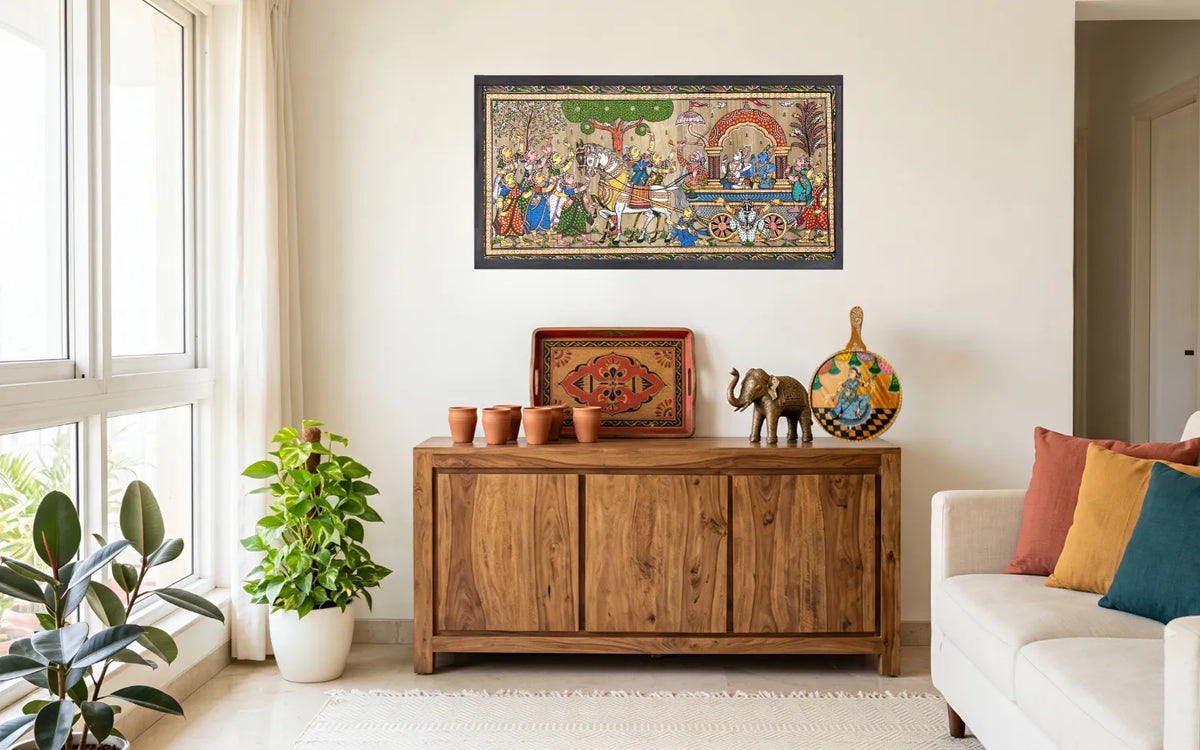
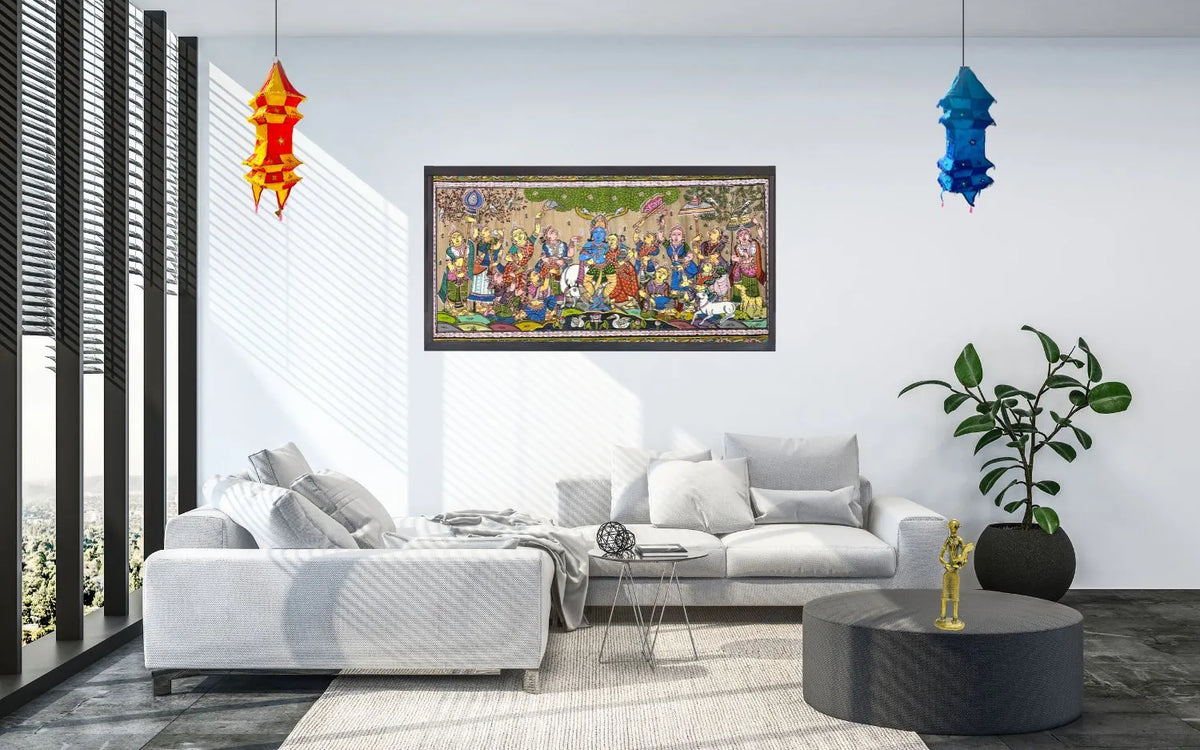
Start with the primary wall, the one that faces the main seating area and receives the most visual attention. This is the wall for a single, significant piece. A large Pattachitra painting, with its layered mythological narrative, its floral border, and the depth that natural mineral pigments give the surface, holds a wall with a quiet authority that printed art cannot replicate. A Saura or tribal painting, with its geometric symbolic forms rooted in India's indigenous visual traditions, makes a different but equally powerful statement. Both are handmade by artisan families. Both have a story the room can carry.
According to traditional Vastu Shastra guidance, the north or northeast wall of the living room is considered auspicious for art depicting sacred subjects and deities, as these directions are associated with positive energy and the presence of Kubera, the presiding deity of prosperity. If you prefer a non-directional approach, the wall simply facing the main seating area works as the natural focal point regardless.
For surfaces, the shelf and the console table are where brass and metal craft come into their own. Dhokra brass craft figurines, made using the same lost-wax casting technique that produced the Dancing Girl of Mohenjodaro over 4,000 years ago, have a particular quality on a shelf: the oxidised warm-bronze surface, the tribal motifs, the slight imperfection that makes each piece recognisably handmade. A single elephant or a pair of figurines placed with intention reads as collected, not cluttered.
The lacquer craft wall hangings offer a different wall option for spaces that want colour and folk energy without the weight of a large painting. The vibrant reds, greens, and blacks of lacquer work bring warmth to a room without requiring the investment of a large Masterworks painting.
For lighting, the living room rewards a handcrafted lamp. A hanging lamp in bamboo or applique fabric changes the quality of evening light entirely, casting warmth and pattern in a way that a standard pendant light cannot. Light from a handcrafted source looks different from light from a manufactured one. This is not metaphysical. It is simply a matter of material: natural materials diffuse light, manufactured ones project it.
For a starting point on the full living room, explore Taalapatra's living room decor collection.
The Bedroom: Calm, Not Busy
The bedroom calls for a different sensibility entirely. The guiding question is not what makes an impression, but what you want to wake up to and fall asleep beside.
Sacred and devotional subjects work well here, particularly those with a quality of intimacy and stillness. A Radha-Krishna composition, with its suggestion of celestial love and the warmth of natural pigments on Tussar silk, suits a bedroom wall far better than a large epic narrative. A small Saura tribal painting in muted geometric forms carries a meditative quality that settles a room rather than exciting it.
The wall directly facing the bed is the natural placement for a single medium-sized piece at a height visible from a reclining position. Avoid placing any painting or artwork directly above the headboard. Vastu guidance consistently recommends calm, non-aggressive imagery in the bedroom, with the southwest wall considered auspicious for devotional art related to love and connection.
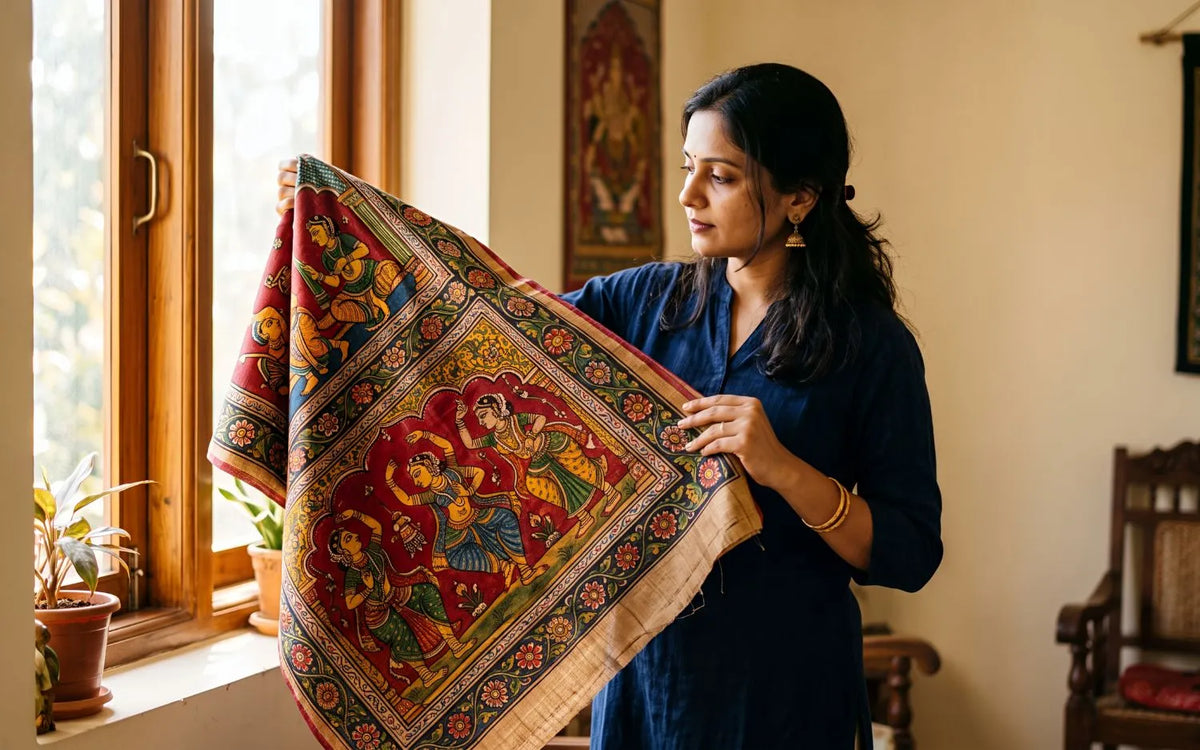
Beyond wall art, the bedroom is where handwoven bedding earns its place. Handwoven cotton bed covers have a texture that manufactured alternatives do not. The slight irregularity of the weave, the natural breathability of cotton that has not been processed with chemicals, the weight of a textile made by an artisan who knows the loom by touch: all of this translates into a quality of sleep and a quality of room that synthetic bedding simply does not produce.
A table lamp on the bedside table, made from a natural material such as terracotta or fabric, completes the room in a way that a plastic or metal lamp does not. Bedside light from a handcrafted source is warmer, more contained, and more suited to winding down than overhead lighting.
Explore the full bedroom essentials collection for pieces suited to this space.
The Entryway: The First Impression Your Home Makes
The entryway is the first thing any visitor sees and the last thing you encounter when you leave. It deserves more attention than most homes give it.
In Indian tradition, the threshold carries significance. It is the boundary between outside and inside, between the world and the home. Traditional Vastu guidance places auspicious art and objects near the entrance, on the north or east wall, to welcome positive energy inward.
An auspicious subject at the entryway does not need to be large. A palm leaf engraving of Lord Ganesha, the remover of obstacles, framed and placed at eye level on the wall nearest the door, is one of the most considered choices for an Indian home threshold. It is small enough not to overwhelm a compact foyer, significant enough to set the entire character of the home.
Door decor is another layer the entryway rewards. Handcrafted door hangings in applique or natural materials bring colour and festive energy to the entrance without requiring wall space.
For homes with more generous entryways, a horn craft figurine on a console shelf or a small terracotta piece placed near the door creates an immediate sense of something curated and intentional. The entryway is rarely the room where people linger, but it is always the room that creates the first impression. One well-chosen handcrafted object does more here than ten generic decorative pieces combined.
The Kitchen and Dining Area: Where Everyday Becomes Cultural
The kitchen and dining area is the most overlooked space in Indian home decor conversations, and one of the most rewarding to get right.
Handcrafted objects in a kitchen carry a warmth that manufactured kitchenware cannot. A terracotta cup set on the counter or dining table, handmade from natural clay and fired in a traditional kiln, changes the experience of drinking chai in a way that is difficult to articulate but immediately felt. The material is naturally cool to the touch. It holds heat differently from ceramic. And it looks like something that belongs in a home, not a catalogue.
Handwoven golden grass table mats and coasters on the dining table bring texture and natural warmth to every meal, without requiring any significant effort or investment. They are the quiet detail that elevates a dining setting from functional to considered.
The kitchen and dining collection at Taalapatra includes terracotta cups, golden grass mats and coasters, and other handcrafted dining essentials that bring the artisan's touch to everyday use.
The Pooja Corner: Sacred Art in Its Natural Home
Of all the spaces in an Indian home, the pooja corner or puja room is where handcrafted Indian art has the deepest roots. Pattachitra painting, as a tradition, began in Odisha as a devotional practice: a way of making the divine portable and present in homes far from the Jagannath Temple at Puri.
The northeast corner of the home is considered the most sacred zone according to Vastu Shastra, associated with spiritual clarity and divine presence. This is the traditional placement for the puja room or mandir corner. Within the space, deity images and sacred art should ideally face east, so the worshipper faces east during prayer.
A Pattachitra painting of Lord Jagannath, Lord Ganesha in his Panchmukhi form, or a scene from the Ramayana brings both devotional weight and artistic depth to a puja space. The natural mineral pigments, the hand-built detail, the sense that a Chitrakar artisan's daily practice of devotion went into the making: these qualities are not incidental. They are the point.
For smaller puja spaces, a palm leaf engraving on the wall carries as much spiritual presence as a large canvas piece. The monochrome black-on-natural-beige quality of palm leaf art is quietly powerful in a compact sacred corner.
The Home Office: Depth Without Distraction
A home office benefits from art that offers sustained engagement between periods of focused work, without pulling attention away from the task at hand.
Complex narrative compositions, the kind that reveal new details on each viewing, work particularly well in this space. A Saura tribal painting with its geometric figures rooted in nature and indigenous ritual offers exactly this quality: something to look at for thirty seconds and take something away, or for thirty minutes and still find something new.
A small lacquer craft piece on a desk or shelf adds colour and craft without competing for attention. The compact scale suits the workspace context better than a large wall composition.
Vastu guidance recommends the north or east wall for a study or workspace, as these directions are associated with clarity of thought and new opportunities.
Bringing It Together
The homes that feel most considered, most personal, and most alive are rarely the ones with the most objects. They are the ones where every object was chosen for a reason, where each piece has a story, and where the overall effect is coherence rather than accumulation.
Indian handcrafted art offers exactly this. A Dhokra figurine that carries 4,000 years of craft tradition. A Pattachitra painting that began as a devotional practice in a Chitrakar family in Raghurajpur. A terracotta cup shaped from the earth and fired by hand. Each of these objects brings something into a home that no manufactured piece can: the specific weight of human skill applied to a specific material over a specific amount of time.
Taalapatra's home and living collection covers the full range of handcrafted pieces across all these spaces, from wall art and paintings to lamps and lighting, earthen crafts, metal crafts, and bio crafts made from bamboo, horn, lacquer, straw, and palm leaf. Every piece is sourced directly from the artisan family that made it.
For those who have already explored Pattachitra and want to understand where it belongs in a home in more detail, the Taalapatra blog on Pattachitra in Modern Homes covers placement, framing, Vastu guidance, and gifting in full.
FAQs
How do I start decorating my home with Indian handcrafted art without it looking cluttered?
Start with one room and one significant piece. The living room primary wall, the bedroom facing wall, or the puja corner are the highest-impact starting points. A single authentic handcrafted piece in the right placement does more than ten generic decorative objects. Once the anchor piece is in place, build around it slowly rather than filling the space at once.
Which Indian handcrafted art works best for a modern minimalist home?
Minimalist interiors actually suit Indian handcrafted art well. The plain wall gives any piece room to breathe and be seen. Pattachitra paintings, with their structured composition and natural colour palette, work particularly well against white or cream walls. Dhokra brass figurines on a plain wooden shelf, and terracotta pieces against neutral surfaces, all gain presence rather than losing it in a minimal setting.
What is the Vastu guidance for placing art in the home?
Traditional Vastu Shastra recommends the north or northeast wall for sacred and devotional art in the living room, as these directions are associated with positive energy and prosperity. The northeast corner of the home is considered the most auspicious placement for the puja space. The east wall is associated with new beginnings and health. For a bedroom, calm and devotional subjects are recommended, with the southwest wall considered appropriate for art related to love and connection. These are traditional guidelines, not prescriptive rules, and any qualified Vastu practitioner can provide personalised guidance.
What handcrafted decor works best for a kitchen and dining area?
Terracotta cups, golden grass woven table mats and coasters, and small handcrafted serving pieces are among the most natural choices for a kitchen and dining setting. They are functional as well as decorative, and the natural materials bring warmth to everyday use in a way that manufactured kitchenware does not.
How do I choose between Pattachitra, Saura/Tribal, and Palm Leaf paintings for my home?
Pattachitra paintings, with their dense mythological narratives and vibrant natural colours, work best in prominent spaces: the living room statement wall, the puja corner, or the bedroom wall facing the bed. Saura or tribal paintings, with their geometric and nature-rooted forms, suit the study or home office particularly well. Palm leaf engravings, with their monochrome quality and compact scale, work beautifully in compact spaces, smaller wall sections, and puja corners where a large canvas would overwhelm.
Does Taalapatra offer handcrafted home decor across all these categories?
Yes. Taalapatra's home decor range covers paintings, lamps, Dhokra and brass craft, terracotta, lacquer craft, bamboo craft, horn craft, applique craft, bedding, kitchen and dining, and wall and door decor. Every piece is sourced directly from artisan families, with no middlemen between the maker and you.
Is Indian handcrafted home decor suitable for gifting?
It is among the most considered gifting choices available, particularly for housewarmings, weddings, and festivals. Handcrafted pieces carry cultural meaning, are unrepeatable, and age with character in a way that manufactured gifts do not. A Pattachitra painting, a Dhokra figurine, a set of terracotta cups, or a handcrafted lamp are all gifts that hold the wall, the shelf, and the table for years.
The content in this blog is based on the author's research and understanding at the time of writing. While every effort has been made to ensure accuracy, information may vary and evolve over time. Taalapatra welcomes feedback and corrections. If you spot an inaccuracy, write to us at care@taalapatra.com.