Most women who buy a Pattachitra saree spend a long time choosing. This is not a coincidence. The choice asks for something a printed saree never does.
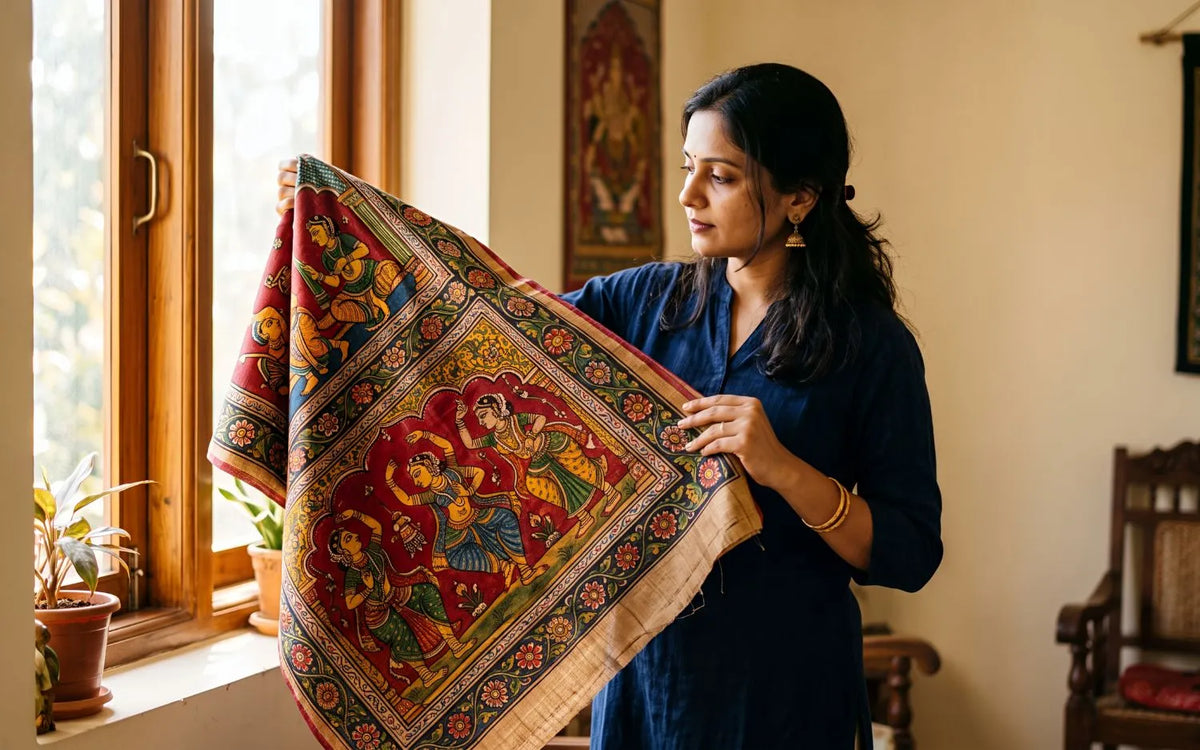
When you hold a Pattachitra saree up to the light, the first thing you notice is the colour. Rich, warm, applied entirely by hand using Fabric Acrylic Colors on Tussar silk by a Chitrakar artisan. The saree catches light differently in the morning than it does in the evening. But that is not what makes the choosing difficult.
What makes it difficult is the motif.
A Pattachitra saree does not just have a pattern. It carries a subject. A story. A visual tradition that Chitrakar artisan families across Odisha have been working within for centuries. When you choose the motif, you are choosing what that story is. And that is a different kind of decision from choosing a colour.
This guide is for anyone who wants to understand that decision fully before making it.
If you are new to Pattachitra entirely and want to understand how these sarees are made, Taalapatra's earlier piece on the story of Pattachitra hand-painted silk covers the craft and process in full. This guide picks up where that one ends: at the moment of choosing.
The Motif: What Is Your Saree Saying?
Every Pattachitra saree tells a specific story. The motif is not decoration. It is the content. And different subjects carry different emotional registers.
The Dancing Women
The most widely painted subject in Pattachitra outside of purely devotional works. Groups of women in traditional poses, their figures rendered with the characteristic bold outlines and natural colour fills of the Pattachitra tradition, their gestures drawn from Odissi dance and temple sculpture. The composition is joyful and celebratory. It carries the energy of collective feminine expression, of women moving together in ritual and ceremony.
This motif works across a wide range of occasions precisely because it is not tied to one specific narrative. It is festive without being exclusively religious. It is artistic without being abstract. For a woman who wants a Pattachitra saree that can be worn to a wedding reception, a festival, a celebration, or a cultural event with equal ease, the Dancing Women is the most versatile choice in the tradition.
Taalapatra's Pattachitra collection currently includes Dancing Women compositions in blue silk, purple silk, and light peach Tussar silk: three readings of the same subject, each carrying a distinct mood.
The Palki
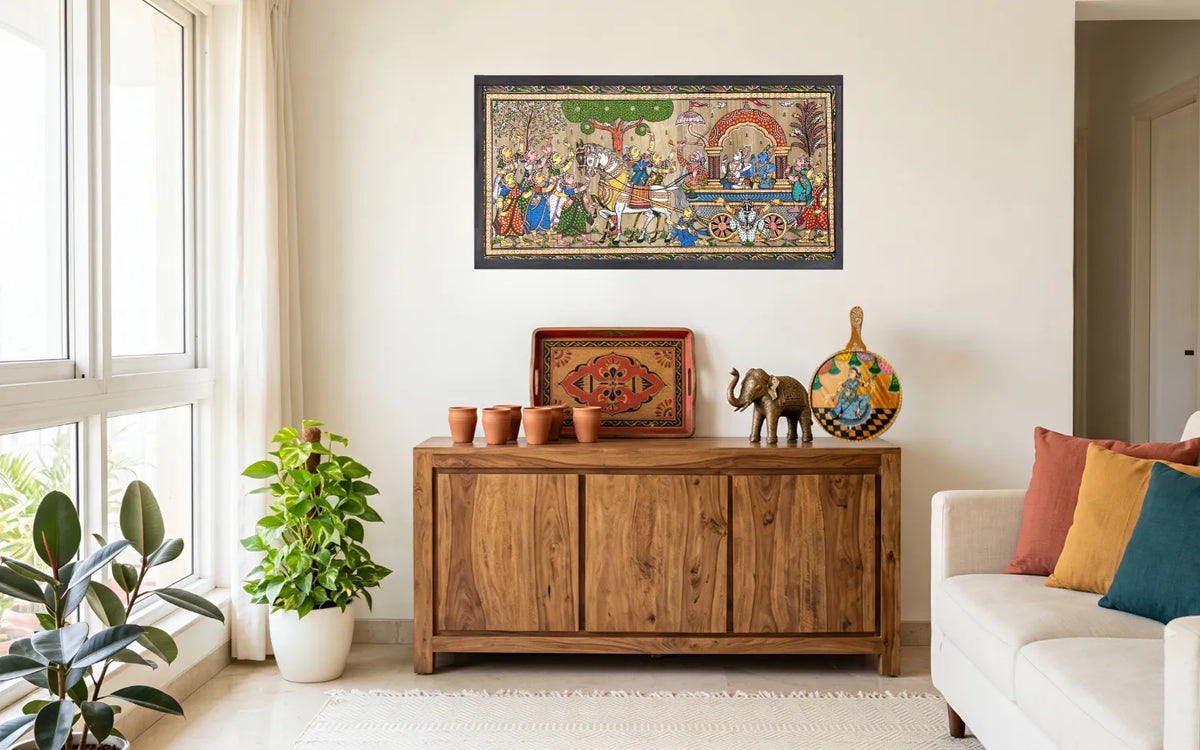
A palki is a palanquin. The procession scene in Pattachitra, where figures carry a palki with a central figure inside while attendants walk alongside with flowers, lamps, and ceremonial objects, is one of the tradition's oldest compositional forms. In the devotional context, the palki procession depicts a divine figure being carried in ceremony. In the folk context, it is often a wedding or a royal procession.
The Palki motif carries a quality of ceremony and occasion that the Dancing Women does not. It is more formal, more narrative, more weighted. A woman who wants her saree to feel like an event rather than a garment will find the Palki composition resonant.
In Taalapatra's collection, the Palki appears in sea green silk and red silk. The red, in particular, sits within the traditional colour associations of ceremony and auspiciousness in Indian culture.
Radha Krishna
The divine love of Radha and Krishna is the most layered subject in all of Indian devotional art. In Pattachitra, the Radha-Krishna composition carries the warmth and intimacy of the tradition at its most lyrical. The two figures, their gestures turned toward each other, surrounded by the natural world of Vrindavan, rendered in Fabric Acrylic Colors by the Chitrakar artisan's hand: this is a composition that rewards sustained looking.
Taalapatra's Radha-Krishna Pattachitra saree in cadmium green places this subject against a colour that is unusual enough to feel considered, traditional enough not to feel foreign.
A Radha-Krishna saree is particularly suited to a couple's celebration, a wedding context, or any occasion that carries personal devotional significance. It is also among the most meaningful choices for a wedding gift.
What the Colour Does
In Pattachitra sarees, the base colour and the painted motif work together rather than independently. The colour does not compete with the painting. It frames it.
Deep colours, a blue, a purple, a wine, a midnight green, make the Fabric Acrylic Colors of the Pattachitra motif appear more luminous by contrast. The reds and yellows in the painting seem to glow against a dark ground. This is one reason why Pattachitra on dark-ground silk reads as more formal and composed.
Lighter colours, a peach, a cream, the natural warm tone of undyed Tussar silk, give the painted motif room to breathe. The composition sits on the surface with less drama and more serenity. A light-ground Pattachitra saree tends to read as more relaxed, more wearable for daytime occasions, more suited to a woman who wants the art present but not insistent.
The choice between light and dark ground often reflects the occasion as much as the aesthetic. A daytime function, a festive gathering in natural light, an outdoor celebration: the lighter grounds serve these contexts better. An evening event, a formal ceremony, a cultural performance: the darker grounds have more presence.
Choosing for the Occasion
A Pattachitra saree is not, by nature, a casual choice. It announces itself as art. This is not a limitation. It is useful information for matching the saree to the occasion.
Weddings and receptions: Any Pattachitra saree works here, though the choice of motif matters. A Palki composition has a ceremonial quality that suits a wedding function. A Radha-Krishna saree carries devotional weight that is particularly resonant in that context. A Dancing Women composition is festive and celebratory. What all Pattachitra sarees share for wedding occasions is the quality of being a genuine collector's piece, an alternative to the more common zari-heavy or embroidered options that still signals care, craftsmanship, and cultural depth.
Festivals and cultural events: The Dancing Women and Palki compositions are at home here. The celebratory energy of the motif matches the occasion. The colours of Pattachitra, warm reds, deep blacks, the warm golds of Fabric Acrylic Colors on silk, also suit the visual landscape of festival settings.
Puja and devotional occasions: A Radha-Krishna composition is a natural choice. The art tradition itself was born from devotional practice, and wearing it to a religious occasion is not just acceptable. It is, in a very particular sense, returning the art to its original purpose.
Personal milestone celebrations: Birthdays, anniversaries, achievements, occasions that mark something meaningful in a life. This is where a Pattachitra saree has a quality that few other sarees can match: it is a collector's piece that the wearer will remember the occasion of. Fabric Acrylic Colors, when properly cared for, hold their vibrancy well. The Tussar silk will soften over time in a way that makes it more, not less, beautiful to wear. These are garments for decades, not seasons.
How to Style a Pattachitra Saree
The first rule is restraint in accessories. The painting is already the statement. Jewellery that competes with it reduces the impact of both.
Simple gold jewellery: small studs or drops for the ears, a single thin bangle or a thin gold chain, works well for most Pattachitra sarees. Oxidised silver jewellery, or brass pieces with tribal forms, pair naturally with the earthier tones of Tussar silk Pattachitra sarees. Dhokra jewellery, made using the same ancient Indian craft tradition as the painting itself, is a particularly considered pairing.
The blouse deserves thought. A plain blouse in the dominant colour of the painted motif, or in the border colour, gives the saree a clean presentation. An overly embellished blouse draws attention to itself. A Pattachitra saree is the art in the ensemble. Everything else should support that.
For hair, simple is again the approach. A single flower, a plain setting, an unadorned bun: these frame the art rather than compete with it.
Why a Pattachitra Saree Is Worth Keeping
In 2026, hand-painted sarees have moved firmly into what the fashion market is calling the collector's category. Not because of branding or trend cycles, but because of what they structurally are: one-of-a-kind objects made by a specific artisan, using a specific motif composition that will not be exactly repeated, in natural materials that age with character rather than degrading.
The Chitrakar artisan who painted your saree cannot reproduce it identically. The motif may be the same subject, but the specific weight of the black outline, the exact depth of colour in a particular area, the slight variation in how the floral border resolves at the corner: none of this repeats. This is not a quality claim. It is a structural reality of hand-painted work.
Fabric Acrylic Colors, when the saree is stored away from direct sunlight, hold their vibrancy well over time. Tussar silk softens with time and becomes more comfortable to drape. A well-kept Pattachitra saree worn for the first time at a wedding will look and feel different, and in many ways better, thirty years later.
That is not something you can say about most fashion.
Taalapatra's Pattachitra saree collection carries pieces sourced directly from Chitrakar artisan families, painted using Fabric Acrylic Colors on Tussar silk, with no middlemen in the chain from the artisan to you. The collection includes Dancing Women, Palki, and Radha-Krishna compositions across a range of colour grounds, each piece available individually, each one singular.
For anyone interested in Pattachitra as an art form and not only as a saree, the Pattachitra painting collection carries standalone works from the same tradition: paintings for walls that speak the same visual language as the sarees that carry it on the body.
FAQs
What is the difference between a Pattachitra saree and a printed saree with Pattachitra motifs?
A hand-painted Pattachitra saree is painted stroke by stroke by a Chitrakar artisan using Fabric Acrylic Colors on Tussar silk. No two pieces are identical. A printed saree with Pattachitra-inspired motifs uses digital or screen printing: the process takes minutes, the lines are mechanically uniform, and the motifs are reproductions of a visual style rather than original compositions. The simplest test is the brushwork: in a hand-painted piece, the line has natural variation. In a print, it does not.
Which Pattachitra motif is best for a wedding saree?
All three main motifs in the tradition are appropriate for weddings, with different qualities. The Palki (palanquin procession) carries a ceremonial weight that suits the wedding ritual context directly. The Radha-Krishna composition has deep devotional resonance particularly fitting for a couple's celebration. The Dancing Women motif is the most versatile, festive and joyful across wedding functions and receptions. The choice depends on what quality you want the saree to carry.
Does Taalapatra sell authentic hand-painted Pattachitra sarees?
Yes. Every saree in Taalapatra's Pattachitra collection is hand-painted by Chitrakar artisan families from across Odisha, using Fabric Acrylic Colors on Tussar silk. Each piece is sourced directly from the artisan family with no traders in between. The collection is small by design. These are not mass-produced pieces.
How do I care for a Pattachitra saree?
Store away from direct sunlight, which can affect Fabric Acrylic Colors over time. Keep in a cool, dry space, ideally wrapped in muslin cloth. Do not machine wash. Dry cleaning is the safest method. Avoid contact with perfumes or chemical sprays on the painted surface. With this care, a Pattachitra saree will hold its colour and character for decades. Details can also be found in the product page.
Can a Pattachitra saree be worn for occasions other than weddings?
Yes. A Pattachitra saree suits any occasion that calls for considered, artistic Indian ethnic wear: festivals, cultural events, puja occasions, milestone celebrations, formal receptions. The motif and colour ground guide the degree of formality. A light-ground Dancing Women saree works well for daytime festive occasions. A dark-ground Palki or Radha-Krishna saree carries more weight for formal evening events.
What jewellery pairs best with a Pattachitra saree?
Simple gold jewellery: small ear drops, a thin bangle or a slim chain, works for most Pattachitra sarees. Oxidised silver or brass tribal jewellery pairs well with the earthier Tussar silk grounds. Dhokra brass jewellery, another ancient Indian craft tradition, pairs naturally with the painted quality of the saree. Avoid heavily embellished or statement jewellery that competes with the painting.
Is a Pattachitra saree a good gift?
It is among the most considered saree gifts available. A hand-painted Pattachitra saree on Tussar silk is singular, carries cultural depth, and will hold its quality for decades. It suits weddings, milestone birthdays, anniversaries, and occasions that deserve something lasting. For gifting enquiries or personalised recommendations, Taalapatra can be reached at care@taalapatra.com or via the contact page.
The content in this blog is based on the author's research and understanding at the time of writing. While every effort has been made to ensure accuracy, information may vary and evolve over time. Taalapatra welcomes feedback and corrections. If you spot an inaccuracy, write to us at care@taalapatra.com.