When a Painting Becomes a Saree: The Story of Pattachitra Hand-Painted Silk
There are sarees that are woven. There are sarees that are printed. And then there are sarees that are painted, by hand, stroke by stroke, by an artisan who has spent a lifetime learning how to turn silk into a canvas for sacred stories. This is about the third kind.
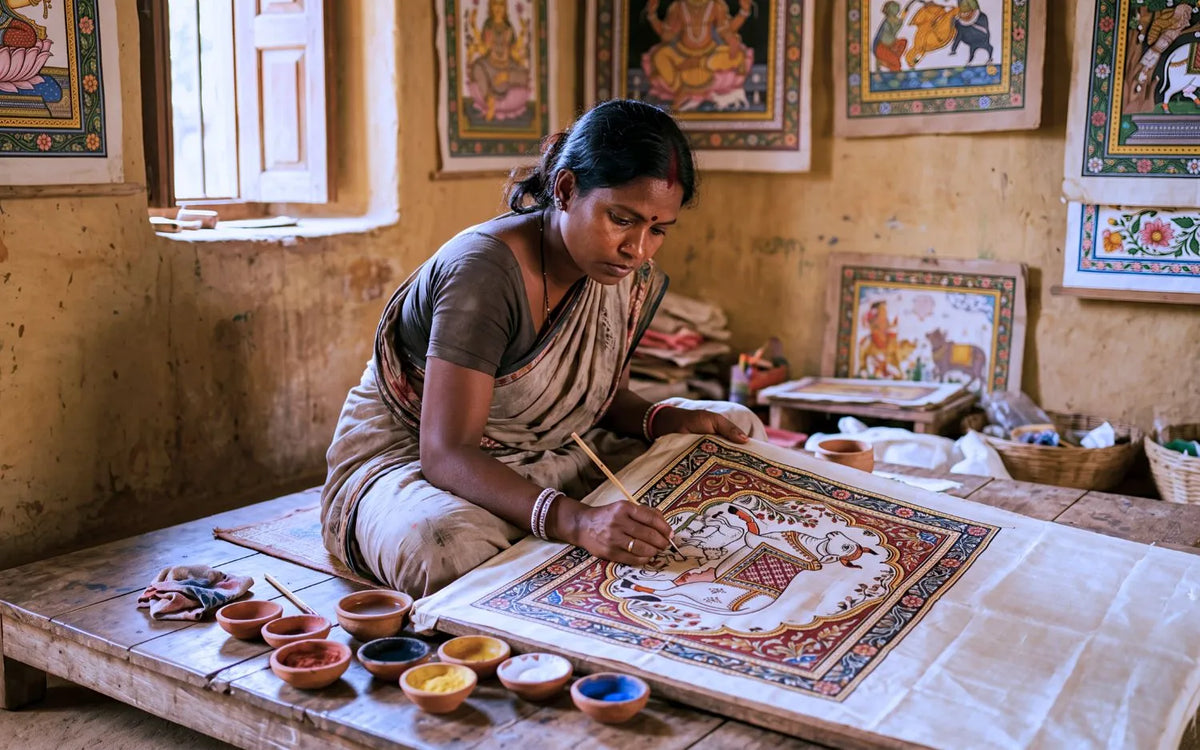
Pick up a Pattachitra saree and hold it up to the light. The surface catches the warmth differently from a printed saree. The colours have a depth that fabric printing cannot replicate, because they were not applied through a screen or a block. They were painted on, by a fine brush, dipped into pigments ground from minerals and plant sources that the Chitrakar family has used for generations.
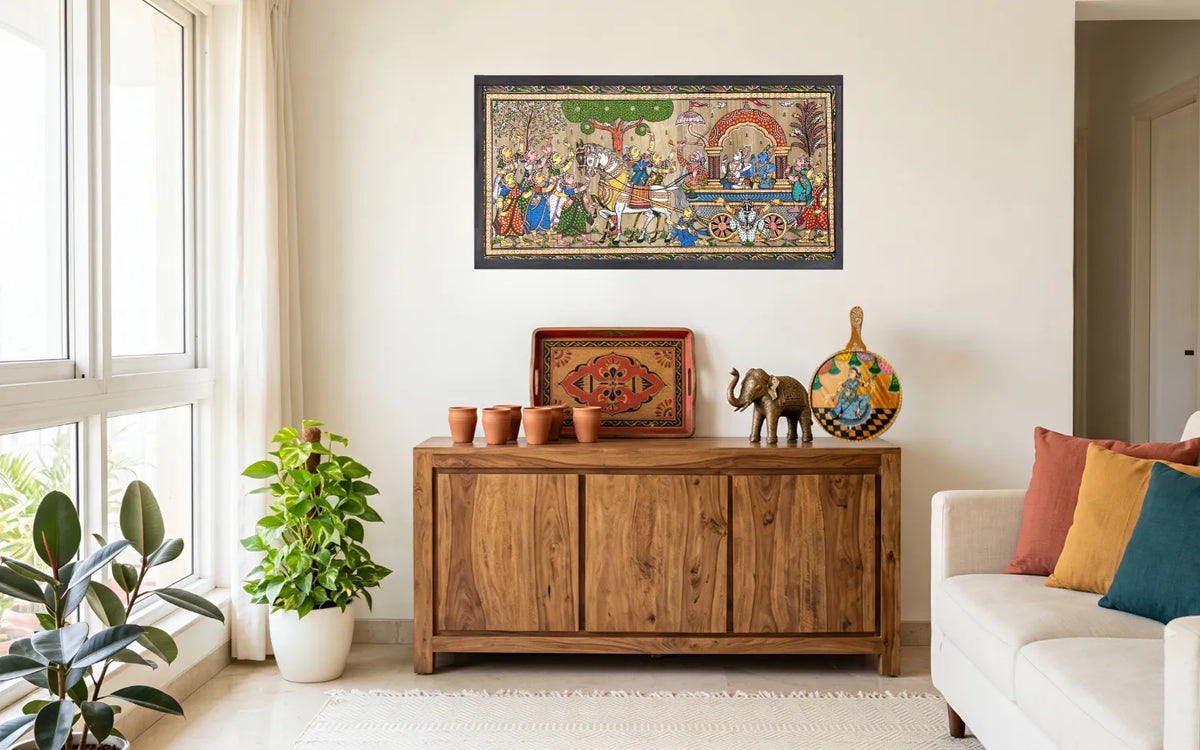
The motif you are looking at, whether it is Lord Jagannath, Radha and Krishna mid-dance, or a procession of figures from the Ramayana, was sketched freehand on silk before a single colour was added. The black outline came first, then the base colours, then the intricate details, then the lacquer finish that seals everything in place and gives the surface its characteristic sheen. No two Pattachitra sarees are identical. The hand that painted one cannot reproduce the exact weight of a line, the precise placement of a motif, the specific depth of a red mixed fresh that morning. Each piece is a singular act of creation.
That is not a marketing claim. It is the structural reality of how Pattachitra painting works, and it is what separates this saree from every other kind.
The Tradition Behind the Textile
Pattachitra as an art form has been practiced in Odisha since before the 15th century. The word itself comes from the Sanskrit patta (cloth) and chitra (picture): a painting on cloth. The tradition is inseparable from the Jagannath Temple at Puri, where the Chitrakar community, hereditary painters whose craft passes from parent to child, created Pattachitra as a devotional act, a way of making the divine portable and present in homes far from the temple.
For centuries, Pattachitra lived on cloth canvases, palm leaves, and the walls of temple precincts. The idea of painting directly onto a silk saree is a natural evolution of the same logic: if the painting can be hung on a wall, it can be draped on a body. The sacred narrative does not change. The silk simply becomes a different kind of canvas.
The village of Raghurajpur in Puri district is the heartland of this tradition today. Recognised as a heritage crafts village, Raghurajpur is home to Chitrakar families who have carried this art form across generations without interruption. Every household there is a working studio. Children grow up watching parents paint, absorbing the visual grammar of the tradition, the specific weight of the black outline, the hierarchy of colours, the motifs that belong to particular subjects, before they are ever formally taught.
Odisha Pattachitra holds a Geographical Indication tag, a formal recognition of its regional origin and the authenticity of the craft's technique and tradition.
What Goes Into the Painting
Before a Chitrakar artisan touches the silk with a brush, the silk itself is prepared. Tussar silk, with its characteristic natural texture and sheen, serves as the base for Pattachitra sarees. Its surface holds the natural pigments differently from machine-woven synthetics: with more depth, more warmth, more texture. The preparation of the fabric ensures it can absorb the layers of paint without bleeding or distorting the fine linework.
The colours used are Fabric Acrylic Colors, a professional-grade medium specifically formulated for fabric painting on silk. Applied by a trained hand, Fabric Acrylic Colors allow the Chitrakar artisan to achieve the fine linework, rich palette, and detailed motifs that Pattachitra is known for. Every line is drawn freehand. Every area of colour is applied by the same brush that draws the outline. Nothing is printed, pressed, or stamped.
The brushes are made by hand, from the hair of domestic animals tied to bamboo sticks, the finest ones thin enough to draw lines that appear drawn rather than painted. The most detailed work requires brushes that hold just a few hairs: the expressions in a figure's face, the intricate patterns of a temple border, the layered petals of a lotus motif.
The painting sequence follows a strict internal logic. The black outline comes first, sketched freehand across the silk without a pencil or tracing. This outline defines the entire composition: every figure, every border, every decorative element. Getting the outline right is not a matter of practice that reaches perfection. It is a matter of years of daily practice that reaches consistency. Even the most experienced Chitrakar does not use a ruler or a stencil.
Base colours fill next. Then the details. Then the layered elaboration of motifs that gives Pattachitra its characteristic visual density. A single saree can take weeks. A complex piece with a full narrative scene across the body and pallu, with fine border detailing, can take considerably longer.
What the Saree Carries
A Pattachitra saree is not simply a decorated textile. It carries the accumulated visual knowledge of a community that has been painting sacred narratives for centuries. The motifs are not decorative choices. They are a language.
Lord Jagannath, the presiding deity of Odisha's cultural and spiritual identity, appears most frequently. The large eyes, the characteristic simplified form, the devotional weight that every Chitrakar family carries in their relationship with this subject: all of this is present in the painting. A saree painted with a Rath Yatra scene carries the full narrative of the chariot festival, the procession of deities, the tide of devotees.
Radha and Krishna in the raas leela, their celestial dance, carry a different emotional register: romantic and devotional simultaneously, a subject that Pattachitra renders with a particular tenderness. Ganesha, painted with five faces in the Panchmukhi tradition, is an auspicious presence on a saree worn for a festival or a new beginning. Scenes from the Ramayana and Mahabharata compress epic narratives into compositions that a viewer can spend considerable time reading.
These are not stories most people need to be told. They are stories Indian women already carry. Wearing a saree that depicts them is a different kind of relationship with a tradition than simply wearing a printed textile with a decorative pattern.
The Silk That Holds the Story
Tussar silk, woven from the cocoons of silkworms that thrive in India's sal and arjuna forests, has a quality that no manufactured fabric replicates. Its natural texture, the slight irregularity of the weave, the warm golden-beige tone that the undyed silk carries, gives Pattachitra painting a foundation that enhances rather than competes with the art. The surface has just enough texture to catch light from different angles, so a saree that appears one way in morning light reads differently in the warmth of evening.
The combination of Tussar silk and Pattachitra hand-painting is not accidental. Tussar silk's natural texture, the slight irregularity of the handloom weave, gives the Fabric Acrylic Colors a surface depth that machine-made synthetic fabric does not offer. The warmth of undyed Tussar silk and the vibrancy of the hand-applied colours work together in a way that is particular to this pairing.
Caring for a Pattachitra saree requires the same principles as caring for the Pattachitra paintings themselves: away from direct sunlight, away from moisture, never machine washed, stored flat or carefully rolled in muslin. Dry cleaning is the safest method. With this care, a Pattachitra silk saree will outlast most garments in any wardrobe, and grow more personal with each wearing.
A Saree That Cannot Be Mass-Produced
This distinction is worth stating clearly, because the Indian market has numerous sarees that use Pattachitra-inspired printed designs. They are printed through digital printing, block printing, or screen printing, and they cost a fraction of a hand-painted piece.
There is nothing dishonest about a printed textile with Pattachitra motifs, if it is presented accurately. The problem arises when the two categories are confused. A printed Pattachitra-inspired saree and a hand-painted Pattachitra silk saree are not the same object. One is a reproduction of a visual style. The other is an original work of art made by a human being whose family has been making this art for generations.
The simplest test: look at the brushwork. In a hand-painted saree, the line has variation. It is thicker where the artisan paused, thinner where the brush moved quickly. The line of a motif painted freehand has the slight imperfection of a human hand. In a printed saree, the line is mechanically consistent. Both sides of every stroke are equally sharp.
That variation in the hand-painted line is not a flaw. It is the evidence that a person made this.
What Taalapatra's Pattachitra Sarees Carry
Every Pattachitra saree in Taalapatra's Pattachitra saree collection is hand-painted on Tussar silk using Fabric Acrylic Colors by Chitrakar artisan families from across Odisha. The collection includes sarees painted with mythological narratives, divine subjects, and tribal motifs, each one a singular piece that will not be repeated.
The Hand Painted Tussar Silk Saree with Dancer Design in the collection is an example of how Pattachitra's visual vocabulary extends beyond purely mythological subjects. The group dance design body, painted on the natural warm beige of undyed Tussar silk, carries the geometric precision and visual energy of Odisha's cultural art tradition, translated into the Chitrakar's painting language.
For those drawn to the standalone paintings in this tradition, Taalapatra's Pattachitra Painting collection carries works on canvas and silk ranging from small intimate pieces to large Masterworks-level paintings, sourced from award-winning Chitrakar artists from the same tradition.
FAQs
What is a Pattachitra saree?
A Pattachitra saree is a hand-painted silk saree where a Chitrakar artisan paints traditional Pattachitra art directly onto the fabric using Fabric Acrylic Colors on Tussar silk. Unlike printed or woven sarees, every Pattachitra saree is an original hand-painted work, with motifs drawn from Hindu mythology, Jagannath tradition, or tribal art. Each saree is unique and cannot be exactly reproduced.
How is a Pattachitra saree different from a printed saree with Pattachitra motifs?
A hand-painted Pattachitra saree is painted stroke by stroke by a Chitrakar artisan using Fabric Acrylic Colors and handmade brushes. The lines have the natural variation of a human hand. A printed saree with Pattachitra-inspired designs uses digital, block, or screen printing: the lines are mechanically uniform, and the process takes minutes rather than weeks. Both exist in the market; only the hand-painted version is authentic Pattachitra work.
What fabric is used for Pattachitra sarees?
Pattachitra sarees are typically painted on Tussar silk, which comes from forest silkworms and has a natural texture, sheen, and warm tone that holds hand-applied Fabric Acrylic Colors particularly well. The smooth yet slightly textured surface of Tussar silk enhances the depth and vibrancy of natural pigments compared to synthetic fabric.
How long does it take to paint a Pattachitra saree?
Depending on the complexity of the composition and the detail of the motifs, a Pattachitra saree can take several weeks to complete. Complex narrative scenes covering the full length of the saree with fine border detailing can take considerably longer.
How do I care for a hand-painted Pattachitra saree?
Keep it away from direct sunlight, which can affect Fabric Acrylic Colors over time. Store in a cool, dry place, away from moisture. Do not machine wash. Dry cleaning is the safest method. Store flat or rolled carefully in muslin cloth. Avoid contact with perfumes or chemical sprays near the painted surface. With proper care, a Pattachitra silk saree will hold its colour and character for decades. Detail care guide can be found in the product page of the saree.
Does Taalapatra sell authentic hand-painted Pattachitra sarees?
Yes. Every saree in Taalapatra's Pattachitra saree collection is hand-painted on Tussar silk using Fabric Acrylic Colors by Chitrakar artisan families from across Odisha. These are professional-grade colours formulated for painting on silk. No two pieces are identical. Taalapatra sources directly from artisan families with no middlemen, ensuring both authenticity and fair return to the artisan who created the piece.
Can a Pattachitra saree be worn for weddings or formal occasions?
Yes. Pattachitra silk sarees are particularly suited to weddings, festivals, and formal occasions where a saree that carries cultural depth is appropriate. The richness of the Tussar silk base, the vibrancy of the hand-applied Fabric Acrylic Colors, and the visual complexity of the painted composition make a Pattachitra saree a genuine collector's piece as well as a wearable one.
DISCLAIMER: The content in this blog is based on the author's research and understanding at the time of writing. While every effort has been made to ensure accuracy, information may vary and evolve over time. Taalapatra welcomes feedback and corrections. If you spot an inaccuracy, write to us at care@taalapatra.com.