It begins with an insect, ends in a mirror finish, and spins on a lathe in between.
The lathe turns. A stick of red lac touches the spinning wood, and for a moment nothing seems to happen. Then the resin softens, smears and spreads, and the wood begins to glow.
The artisan does not hurry. A second colour goes over the first. A thin stylus draws a spiral through the warm surface, and the colour underneath shows through. A strip of palm leaf comes down, and the finish moves from satin to glass.
Ten minutes ago this was a plain piece of wood. Now it is a colour you could see across a room.
No paint is involved. No brush is involved. The colour comes from a resin, a lathe and a pair of practised hands. It is one of the oldest ways in India to turn wood into colour, and one of the least talked about.
Where the Colour Comes From
Lac is a natural resin secreted by a tiny insect, Kerria lacca, which lives on the tender twigs of particular host trees such as palas, ber and kusum. It is the only natural resin of animal origin. The insect makes it to protect itself, and people in India have been gathering it for a very long time.
The word itself is old. Lac comes from the Sanskrit laksha, and the resin was used in ancient India as a wood finish, a dye and a cosmetic, and to make lacquerware.
The journey from twig to workshop has stages. Branches encrusted with resin are harvested as sticklac. The sticklac is crushed, sieved and washed into seedlac, which can be heated and refined into shellac. In a lac-turner's hands, that resin becomes sticks and blocks of colour.
That first stage is worth remembering. Lac is gathered from forests and farms, and the ICAR Indian Institute of Natural Resins and Gums notes that lac cultivation is an important source of livelihood for forest and sub-forest communities in central and eastern India. Every lacquered piece has a lac grower behind it, before the turner ever touches a lathe.
How Wood Becomes Colour
The steps below follow the process described on Taalapatra's lacquer craft product pages. Methods vary from region to region and workshop to workshop, but the logic is the same everywhere.
Wood. A block of locally sourced softwood is cut and shaped by hand or on a traditional wooden lathe, into circular, oval or custom-carved forms. Lac turnery is traditionally done on soft, close-grained woods that turn cleanly.
Lacquer. Natural resin is melted and mixed with mineral or vegetable-based dyes to make the colours. The artisan applies the lacquer to the rotating wood and layers different shades as the piece turns.
Pattern. While the lacquer is still warm and workable, a thin stick or metal stylus etches or builds up spiral motifs, tribal patterns and floral medallions. In some lacquer traditions, artisans scrape through layers of colour with a chisel to expose the shade beneath. Colour is drawn out of the layers, not painted on top.
Polish. Once dry, the surface is hand-polished with a soft cloth, a palm leaf or bamboo shavings. That is what gives lacquer its glass-like sheen.
Finish. The piece is inspected for symmetry, shine and detail, and its hanging hooks or fittings are added.
Nothing in that sequence needs a machine to think for the artisan. It needs a steady hand, a sense of heat, and patience with drying time.
Why Lac Lasts
Lac is more than a colour. ICAR researchers describe it as a natural, biodegradable, non-toxic and safe resin, which is why it has long been used in coatings, cosmetics and pharmaceuticals as well as craft.
On wood, its strength comes from layering. In the Channapatna tradition described by the government handicrafts portal, natural lacquer is applied in several thin coats, each dried and polished, and that layering adds durability as well as colour. The same principle sits behind the glassy finish of a wall hanging. It is not one thick coat. It is many thin ones, worked by hand.
One Craft, Many Addresses
Lacquer is not one tradition. It is a family of them, and it is a national one.
According to the Government of India's handicrafts portal, wood turning and lacquerware is a traditional Indian art form especially prominent in Channapatna in Karnataka, Varanasi in Uttar Pradesh and Etikoppaka in Andhra Pradesh. Artisans there spin the wood and apply lacquer using heat and friction, often with natural dyes from plants and minerals, to make toys, bangles and decorative items.
In Rajasthan, the term lac-turney describes wooden articles turned on a wheel and coated with several layers of different coloured lac. The lac stick is pressed against the turning object, friction softens the lac, and layers are later scraped with a chisel to expose the colour beneath. Jaipur, Kotah, Udaipur and Jodhpur are among its main centres.
In Kutch in Gujarat, lacquer work is the traditional profession of the Vadha community of lathe-turners, who work with portable lathes powered by a rope and stick.
Same resin. Same idea. Different hands, different woods, different colours, and different objects. What the government portal lists among the products of the craft shows how wide the range is: toys, kitchenware, jewellery boxes, bowls, trays and decorative pieces.
Why It Gets Overlooked
Lacquer is rarely the first craft anyone names. Sarees, paintings and brass tend to get the attention. Lacquer, by contrast, often shows up as an everyday object: a toy, a bangle, a box, a rolling pin. Everyday objects are easy to overlook, and easy to underrate.
That is the argument for looking again. A lacquered piece takes a resin from the forest, a block of wood, a lathe and a series of hand-controlled steps to make. It just happens to be small, bright and useful, which makes it easy to mistake for simple.
Lacquer in a Home
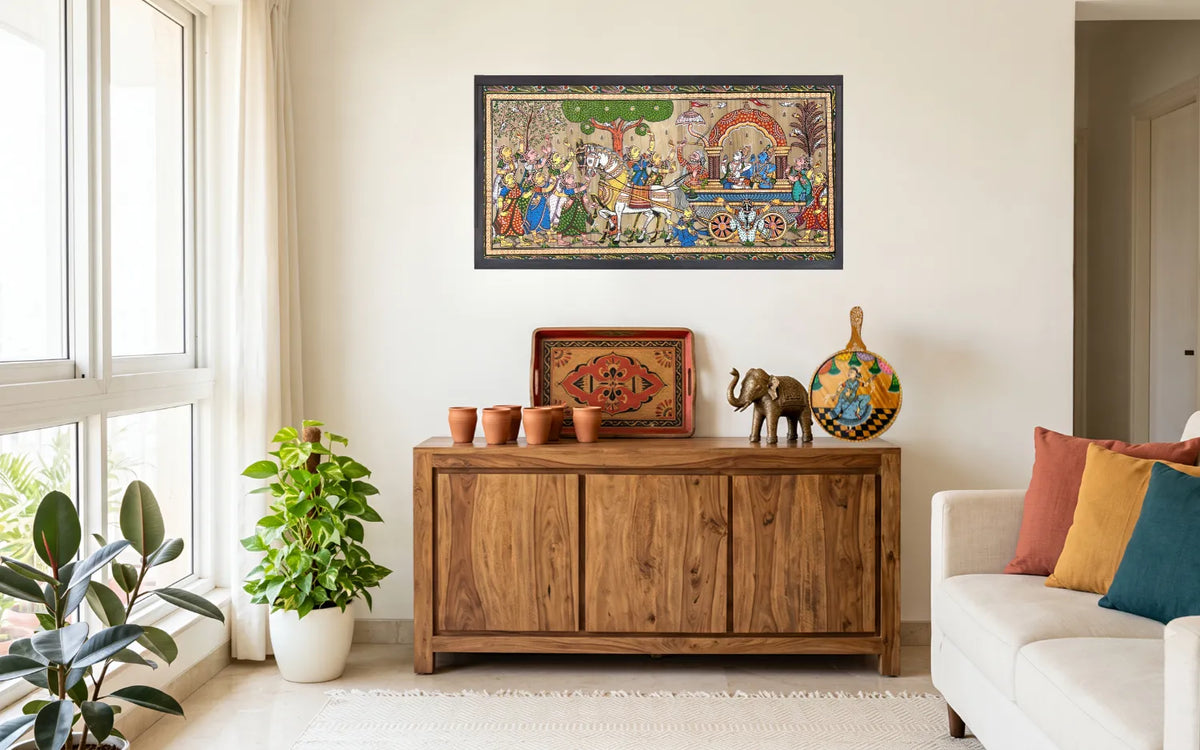
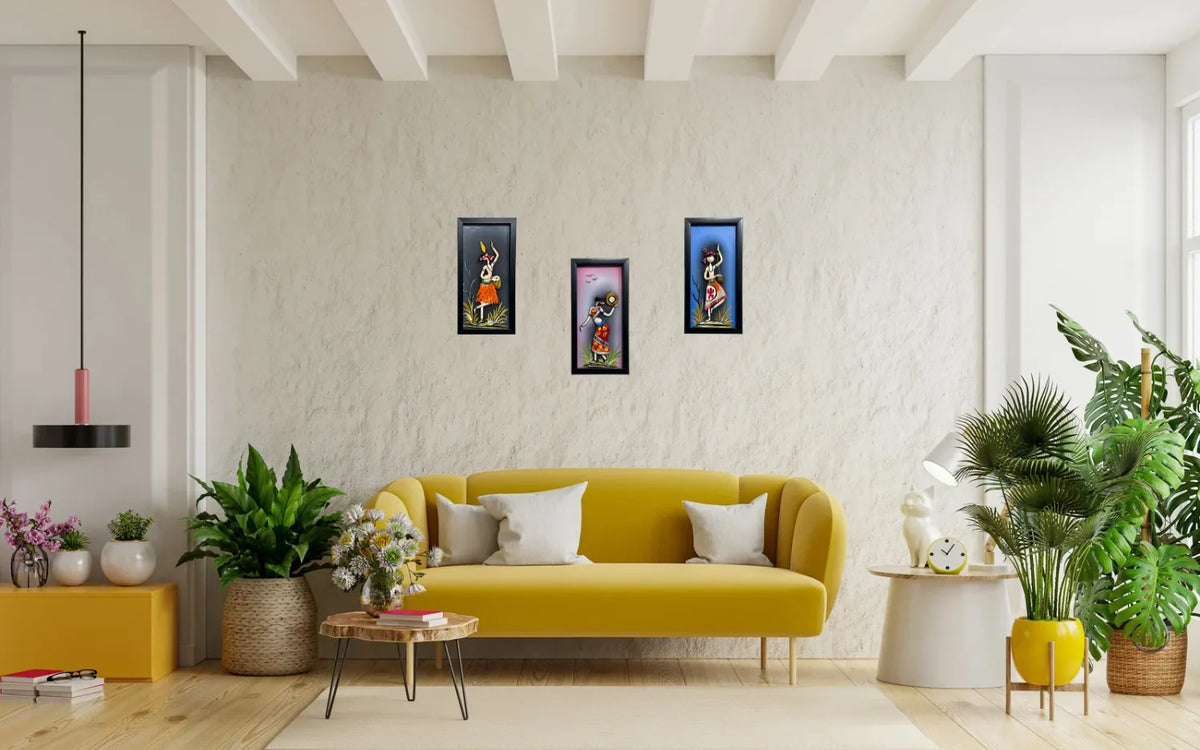
Taalapatra's lacquer craft collection is mostly framed wall hangings, in sets and singles, with folk and tribal subjects: dancing couples, women dancing together, a woman with a deer, and sets of tribal figures. It also includes lacquered bamboo vanity boxes.
Each wall hanging in a set is small, at roughly 30 by 15 centimetres. That is an advantage. Small lacquer pieces work in clusters. The product pages suggest a living room, an entryway, a workspace or a pooja corner. Choose a wall with steady light, and hang the pieces close together so the colours read as a group. For more on where art belongs in each room, see our room-by-room guide to handcrafted home decor.
Lacquer also suits gifting, since it is small, bright and easy to give. If you are choosing for a new home, our housewarming gift guide covers how to match a gift to the person and the room.
Looking After Lacquer
The care guide on Taalapatra's lacquer product pages is short.
Dust regularly. Use a soft, dry cloth or a gentle brush.
Avoid direct sunlight. Long exposure to UV rays can fade the colour over time.
Handle with care. Lacquered pieces can chip if knocked, so lift and hang them gently.
Every handmade piece varies slightly in colour, texture and finish, and colours can look a little different on different screens or in different light. Those small differences are part of a handmade lacquer piece.
The Hands Behind the Shine
Behind a lacquered wall hanging is a chain of hands: the family that gathered the lac, the turner who shaped the wood, the artisan who layered and etched the colour, and the person who polished the surface. Taalapatra sources directly from artisan families, with no middlemen in between.
Choose lacquer, and you keep that whole chain of work in demand. It is a small purchase with a long reach.
FAQs
What is lacquer craft?
Lacquer craft is the Indian art of coating wooden objects with layers of coloured lac, a natural resin secreted by the lac insect. Artisans shape the wood, often on a lathe, build up colour in layers, and polish it to a glass-like sheen.
What is lac made from?
Lac is a natural resin secreted by the lac insect, Kerria lacca, on the twigs of host trees such as palas, ber and kusum. Harvested as sticklac, it is cleaned into seedlac and can be refined into shellac.
How is lacquerware made?
Wood is shaped by hand or on a lathe. Coloured lac is applied in layers as the piece turns, patterns are etched or scraped through the layers, and the surface is polished by hand with cloth, palm leaf or bamboo until it shines.
Where is lacquer craft made in India?
Lacquer craft is practised in several regions. The Government of India's handicrafts portal names Channapatna in Karnataka, Varanasi in Uttar Pradesh and Etikoppaka in Andhra Pradesh, and lac-turney is also traditional in Rajasthan and Kutch.
How do I care for lacquer craft?
Dust it regularly with a soft, dry cloth or gentle brush, keep it out of direct sunlight to prevent fading, and handle it gently to avoid chipping. Follow the care guide on each product page.
Is lacquer craft good for gifting?
Yes. Lacquer pieces are small, bright and handmade, so they suit housewarmings, festivals and celebrations. Choose a piece that matches the recipient's taste and space, and include a note naming the craft.
The content in this blog is based on the author's research and understanding at the time of writing. While every effort has been made to ensure accuracy, information may vary and evolve over time. Taalapatra welcomes feedback and corrections. If you spot an inaccuracy, write to us at care@taalapatra.com.